An ERP system has become the backbone of a modern business. It connects key functions such as finance, operations, sales, and HR into one unified platform. This helps companies improve efficiency, visibility, and decision-making.
When choosing an ERP, one of the first decisions is whether to go with an open-source or a proprietary solution. Open-source ERP systems offer access to the source code and greater flexibility for customization. Proprietary ERP systems are licensed or subscription-based platforms managed by a single vendor, often with structured support and built-in compliance features.
There is no one-size-fits-all answer. The right choice depends on your business goals, budget, technical capabilities, and long-term growth plans.
Table of Contents
Understanding open-source ERP
Open-source ERP means the software source code is publicly available, enabling developers to view, modify, and extend the system to meet the business’s needs. This includes:
- Access to source code: Developers are not restricted to predefined features. They can modify workflows, logic, and features.
- Freedom to customize: The system can be customized to meet unique business demands.
- Community-driven development: A common community of developers continuously contributes to improving and expanding the platform.
- Self-hosting flexibility: Businesses can host the ERP system on their own server or on third-party platforms, such as AWS, Google Cloud, or Azure.
- Lower licensing barriers: Most of the open-source ERP platforms are free to use, reducing upfront software costs.
*Note: Open-source doesn’t mean completely free. It includes implementation, customization, infrastructure, and support costs.
Advantages of open-source ERP systems
Open-source systems offer several business benefits, including
- Cost control: Beneficial for companies seeking to avoid high recurring fees.
- High customization capability: Ideal for businesses with unique or complex workflows, such as dairy businesses.
- Reduced vendor lock-in: Since open-source is accessible, they do not need to rely on a single vendor.
- Large developer ecosystem: A large network of contributors builds plugins and industry-specific modules.
- Rapid innovation: Community modules and enhancements quickly evolve.
Considerations when adopting an open-source ERP system
Open-source also comes with certain considerations that determine the success of open-source ERP implementation. They include:
- Requires technical expertise: ERP system implementation, configuration, and customization require an expert developer or experienced partners.
- Implementation quality is critical: Poor implementation can lead to long-term operational issues.
- Governance and upgrade planning: Customizations must be done correctly to ensure smooth upgrades.
- Variation in module maturity: Community versions may lack the depth or polish of commercial modules.
* Open-source ERP platforms offer flexibility and control; however, they require structured implementation and proactive technical oversight to deliver long-term value.
Understanding proprietary ERP
A proprietary ERP system is owned and developed by a single vendor. The source code is not publicly available, and the customers use the software under a paid license or subscription model. The key characteristics of proprietary ERP include:
- Closed-source platform: Users cannot access or modify the core system code.
- Subscription-based licensing: Typically priced per user, per module, or per month.
- Vendor-controlled roadmap: The vendor decides product updates, features, and long-term direction.
- Managed updates and infrastructure: Especially in cloud-based systems, updates, security patches, and performance management are handled by the vendor.
Business benefits of proprietary ERP
Proprietary ERP systems provide several operational benefits:
- Strong vendor support: Direct access to official support channels and service-level agreements.
- Built-in compliance and security: Structured frameworks aligned with global standards.
- Predictable upgrade path: Regular vendor-managed updates reduce technical overhead.
- Enterprise scalability: Designed to handle large transaction volumes and multi-entity operations.
- Seamless ecosystem integration: Particularly powerful for organizations already invested in the Microsoft stack.
*This makes proprietary ERP especially attractive to mid-sized and enterprise organizations seeking structured digital transformation.
Considerations while implementing a proprietary ERP system
Despite their strengths, proprietary systems involve trade-offs:
- Higher licensing costs: Ongoing subscription fees can be significant over time.
- Vendor dependency: Businesses rely on the vendor for product direction and major changes.
- Limited deep customization: Core system logic cannot be modified beyond supported extension frameworks.
- Cost growth over time: As users, modules, and storage increase, subscription expenses may rise.
* A proprietary ERP system emphasizes stability, governance, and structured scalability, but it requires a long-term financial commitment and alignment with the vendor’s ecosystem strategy.
Open-source vs. proprietary ERP
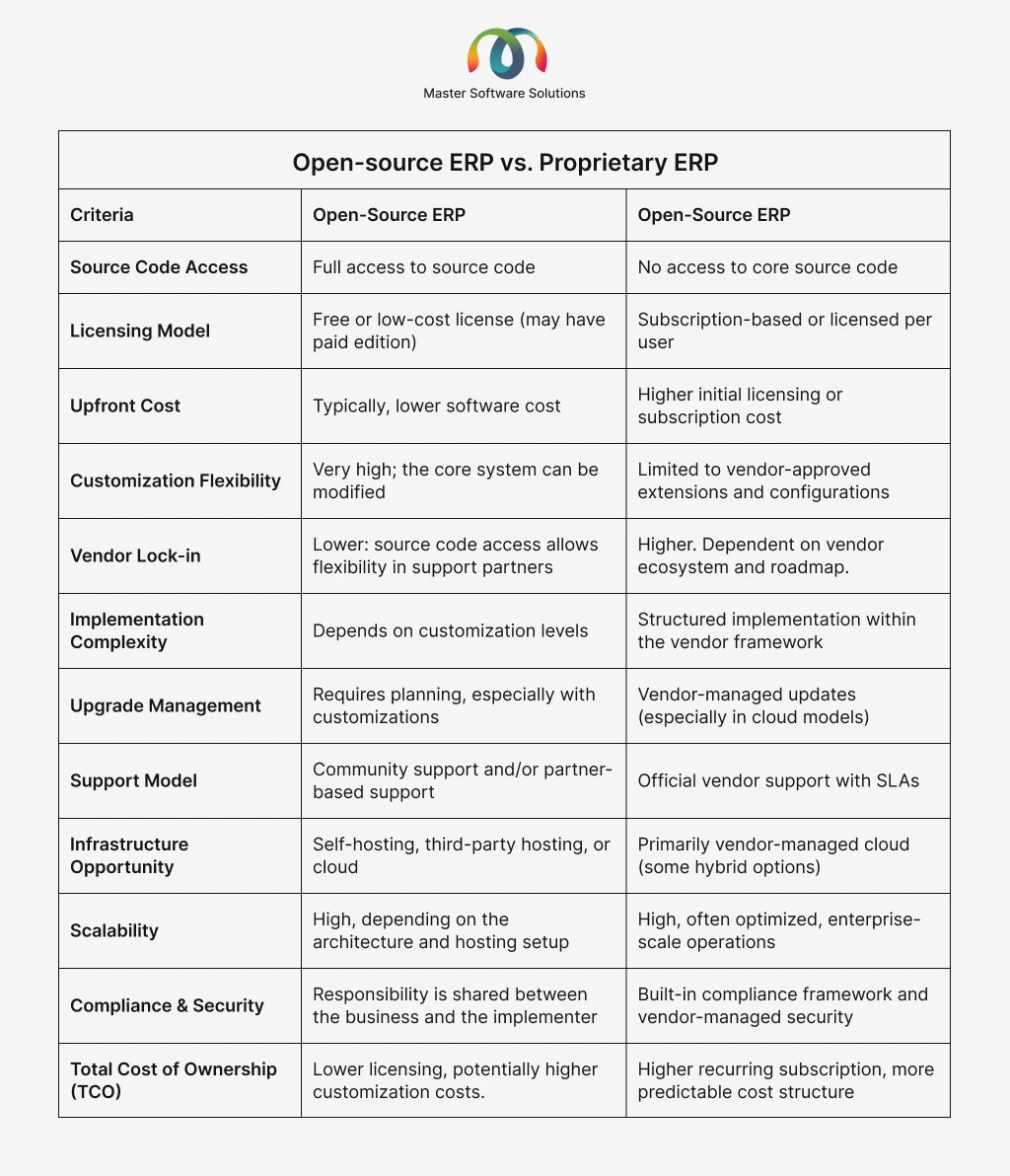
After understanding how open-source and proprietary ERP systems work, the next step is to compare them side by side. While both models aim to streamline operations and improve business performance, they differ in structure, cost model, flexibility, and long-term control.
The comparison below highlights the key differences across important decision factors, including licensing, customization, scalability, vendor dependency, and total cost of ownership. This overview is designed to help decision-makers quickly evaluate which model aligns better with their operational needs, technical capacity, and growth strategy.
Which businesses should choose open-source ERP?
Open-source ERP is not just a “low-cost” alternative. It is a strategic choice that fits certain business profiles particularly well. Below are the types of organizations that typically benefit the most from an open-source model.
Startups and SMEs with budget constraints
Open-source ERP solutions often reduce or eliminate high upfront licensing fees, making them attractive for startups and small- to mid-sized companies. Instead of investing heavily in software licenses, these businesses can allocate budget toward implementation, customization, and growth initiatives.
Business requiring high customization
Some organizations operate with unique workflows that do not align with standard ERP processes. Manufacturing variations, custom service models, or specialized approval chains often require deep system modification. Open-source ERP allows access to the source code, enabling developers to tailor the system closely to operational realities rather than forcing the business to adapt to rigid software structures.
Companies wanting infrastructural control
Organizations aiming to host their systems on-premise or in a private cloud often prefer open-source ERP. This is common in industries with strict data control policies or businesses that want full authority over performance, backups, and system architecture.
Tech-savvy organization with internal IT teams
Companies with internal developers or strong IT partners can manage customizations, integrations, and upgrades effectively. Without technical oversight, the flexibility of open source can become difficult to manage. With the right expertise, however, it becomes a powerful advantage.
Companies with niche or complex workflows
Certain industries operate outside standard ERP templates. Examples include specialized manufacturing, distribution with custom pricing logic, or project-based businesses with unique billing structures. Open-source platforms allow these companies to build industry-specific modules or modify existing ones without being limited by vendor restrictions.
Which businesses should choose open-source ERP?
Proprietary ERP systems are typically best suited for organizations that prioritize structure, scalability, and vendor-backed governance. Below are the business profiles that most commonly benefit from this model.
Mid-to-large enterprises
Proprietary ERP systems are designed to handle high transaction volumes, multi-entity accounting, and advanced reporting requirements. They provide structured frameworks that support enterprise-scale growth without requiring a deep, customized core system.
Companies deeply invested in a specific technology ecosystem
Businesses that already rely heavily on a particular technology stack, such as productivity tools, cloud infrastructure, analytics platforms, and collaboration software. They often gain strong integration benefits from proprietary ERP solutions within the same ecosystem. This reduces integration friction and improves data consistency across systems.
Businesses requiring a global compliance framework
Proprietary ERP platforms often include built-in compliance controls, audit trails, and security certifications aligned with global regulations. For these businesses, structured governance and vendor accountability are critical.
Organizations prioritizing standardized processes
Proprietary ERP systems are typically designed around standardized workflows, encouraging operational discipline and consistency across departments. This approach reduces complexity and simplifies upgrades.
Firms preferring SaaS or managed infrastructure
Proprietary ERP systems, particularly cloud-based SaaS models, shift infrastructure management to the vendor. This allows internal teams to focus on operations and strategy rather than IT maintenance.
Total cost of ownership
When evaluating ERP systems, many businesses focus only on licensing or subscription fees. However, the real financial impact comes from the Total Cost of Ownership (TCO), the full cost of implementing, running, and maintaining the system over several years.
Licensing vs. implementation costs
Open-source ERP often has low or no licensing fees (especially community editions). However, implementation can require significant investment in configuration, development, and testing.
Proprietary ERP typically involves recurring subscription or licensing fees, but implementation may follow a more standardized structure.
* Open source may reduce software cost, but shift more investment into project execution. Proprietary systems may have higher licensing costs but more defined deployment frameworks.
Customization cost
Customization is one of the biggest cost drivers in any ERP project.
- Open-source platforms allow deep customization, which is powerful, but extensive modifications increase development time and long-term maintenance effort.
- Proprietary systems limit core changes, which can control customization costs but may require process adjustments within the business.
* The more you customize, the more you must manage future upgrades and system stability.
Infrastructure cost
Infrastructure expenses depend on deployment strategy:
- Open-source ERP often requires self-hosting or third-party cloud hosting, including servers, backups, monitoring, and cybersecurity management.
- Proprietary SaaS ERP usually includes infrastructure within the subscription cost, reducing internal IT overhead.
* Businesses must decide whether they prefer infrastructure control or managed cloud simplicity.
Upgrade and maintenance cost
ERP is not a one-time project—it is a long-term system.
- Open-source systems require structured upgrade planning, especially when customizations are involved. Each major version upgrade may require testing and revalidation.
- Proprietary cloud systems typically push regular vendor-managed updates, reducing internal upgrade effort but limiting control over timing.
* The trade-off is between flexibility and predictability.
Training and change management
Regardless of the model, user adoption directly impacts ROI.
- Complex custom systems may require more targeted training.
- Standardized proprietary systems may align with documented best practices, but users still need onboarding and process adaptation.
* Ignoring training costs can significantly underestimate TCO.
Choosing the right fit for your business
It’s common to frame the argument between open-source and proprietary ERP systems as “better.” “Which one fits your business model and long-term strategy?” is actually a more pertinent question.
Open source does not automatically mean cheap or simple. While licensing costs may be lower, it requires technical expertise, structured governance, and careful upgrade planning.
“Proprietary” does not automatically mean expensive or rigid. Although subscription costs may be higher, these systems often provide built-in compliance, managed infrastructure, and structured scalability, reducing operational risk.
The right decision depends on alignment with your business in the following areas:
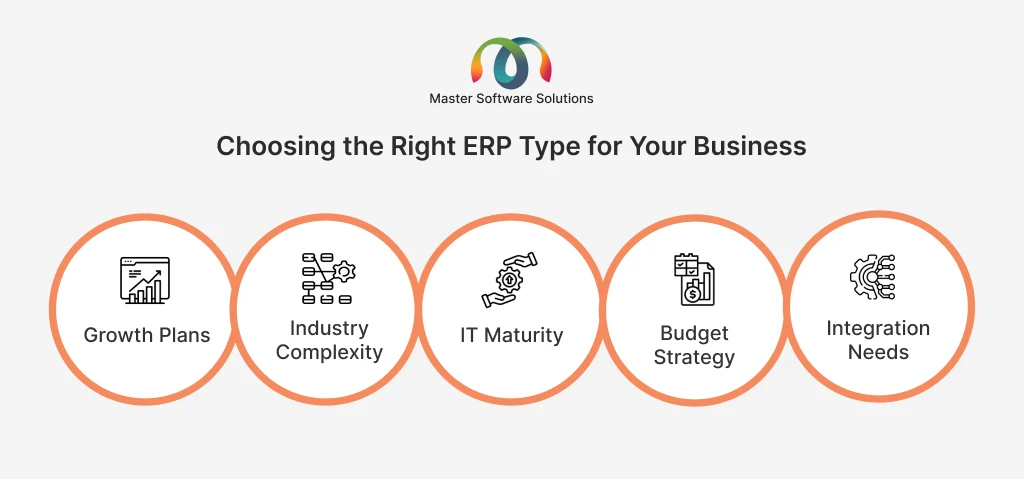
Growth plans
Are you planning rapid expansion, multi-country operations, or acquisitions? Your ERP must scale with you without requiring a full system redesign.
Industry complexity
Does your industry require highly specialized workflows, or can you operate within standardized best practices? Custom-heavy industries may benefit from more flexibility.
IT maturity
Do you have an internal IT team capable of managing infrastructure and custom development? Or do you prefer vendor-managed cloud services?
Budget strategy
Do you want lower upfront licensing costs with potentially higher investment for customization? Or predictable recurring subscription costs with managed services?
Integration needs
Does your business rely heavily on a specific technology ecosystem? ERP alignment with existing tools can significantly impact efficiency and reporting accuracy.
How does Master Software Solutions help choose the right ERP?
Selecting an ERP system is not just a software decision—it is a business transformation decision. At Master Software Solution, our approach is structured, consultative, and outcome-driven. We do not push a specific product; we focus on identifying the right fit for your operational and growth strategy.
Vendor-neutral ERP assessment
We begin with a detailed evaluation of your business environment before recommending any platform. This includes:
- Business process analysis: We study your current workflows across finance, operations, sales, inventory, HR, and reporting. The goal is to understand how your business actually runs—not just how it is documented.
- Gap analysis: We compare your operational requirements with available ERP capabilities to identify functional gaps, automation opportunities, and risk areas.
- ROI modeling: We evaluate implementation cost, long-term ownership cost, and expected efficiency gains to ensure your ERP investment delivers measurable business value.
Implementation expertise across platforms
Once the right direction is clear, we bring deep technical and functional expertise to execution. We work on:
- Odoo Community & Enterprise: We design, customize, and deploy both editions based on your flexibility, scalability, and budget requirements.
- Microsoft Dynamics 365: We implement structured, enterprise-grade ERP solutions with strong ecosystem integration and align with compliance.
- Migration and integration services: We handle data migration, legacy system transitions, third-party integrations, and cross-platform connectivity.
- Custom Development: When standard functionality is not enough, our development team builds tailored modules, extensions, and automation workflows aligned with your business logic.
Long-term ERP partnership
ERP success is not defined at go-live. It is measured over years. This long-term success depends on:
- Ongoing support: We provide structured technical and functional support to ensure system stability and user adoption.
- Optimization and performance tuning: As your business evolves, we refine workflows, reporting structures, and automation strategies.
- Scaling strategy: Whether expanding to new markets, adding entities, or increasing transaction volumes, we ensure your ERP scales with you.
- Upgrade roadmap planning: We proactively manage version upgrades and feature adoption to protect your system investment.
Conclusion
Choosing between open-source and proprietary ERP is not about selecting the most popular option; it is about selecting the right foundation for your business. Both models offer strong capabilities. The difference lies in flexibility, cost structure, governance, and long-term control.
At Master Software Solution, we are not software resellers. We are ERP transformation partners, focused on aligning technology with your business objectives for sustainable growth. Schedule a consultation with our ERP experts and take the first step toward a smarter, more scalable business system.