This is the most uncomfortable question on the list. It is also one of the most important.
No business relationship lasts forever. Circumstances change. You may want to bring Odoo development in-house, switch implementation partners, or migrate to a different platform entirely. Your ERP partner may evolve their focus, be acquired, or change the scope of services they offer.
Both scenarios should be planned for before the relationship begins — not after it ends badly.
Yet the exit strategy is almost never discussed in early-stage conversations with an Odoo implementation partner. Most businesses are so focused on getting the project started that they forget to ask: what happens if we need to leave? What do we actually own? Can another partner take over? Will we be locked in?
These are not pessimistic questions. They are professional ones. And the partners you should trust are precisely the ones who are willing to answer them clearly, upfront, and in writing.
“Having this conversation upfront is not a sign of a shaky partnership. It is a sign of a mature one.” – Master Software Solutions
Why Most Odoo Clients Never Ask About the Exit Strategy and Why That’s a Mistake
The beginning of an ERP implementation is an optimistic time. You have selected your partner, scoped the project, and signed the contract. The last thing anyone wants to discuss is how it might end.
But this is exactly when the exit strategy conversation should happen. Before any code is written. Before any data is migrated. Before your business processes are wrapped around a system that you may not fully understand how to leave.
The reality is that exit terms negotiated at the start of a relationship, when both parties are aligned and motivated, are far more balanced than those negotiated under pressure after a relationship has broken down. By then, time pressure, operational dependency, and emotional friction make it extremely difficult to get a fair outcome.
The Real Risks of Having No Exit Plan
When no exit framework exists, clients who want to change partners or bring Odoo in-house typically face one or more of the following:
- Data held in non-portable formats that require significant effort to export or migrate
- Custom Odoo modules with no documentation, making it almost impossible for another partner to understand, maintain, or extend the code
- Licensing arrangements that are unclear, leaving the client uncertain about what they own versus what they have simply been granted access to
- No defined transition period or knowledge transfer, forcing an abrupt handover that disrupts live operations
- Commercial disputes over IP ownership of customisations built specifically for the client’s business
None of these situations are inevitable. Every one of them can be prevented with a clear, documented exit framework agreed at the start of the engagement.
Red flag: If an Odoo partner is reluctant to discuss exit terms or insists that ‘we can figure that out later,’ treat it as a warning sign. Partners who are confident in the quality of their work welcome this conversation.
What a Responsible Odoo Exit Strategy Should Cover
A professional exit framework is not a lengthy legal document. It is a clear, practical section of your engagement contract that defines exactly what happens on either side if the relationship ends. Here are the four areas it must address:
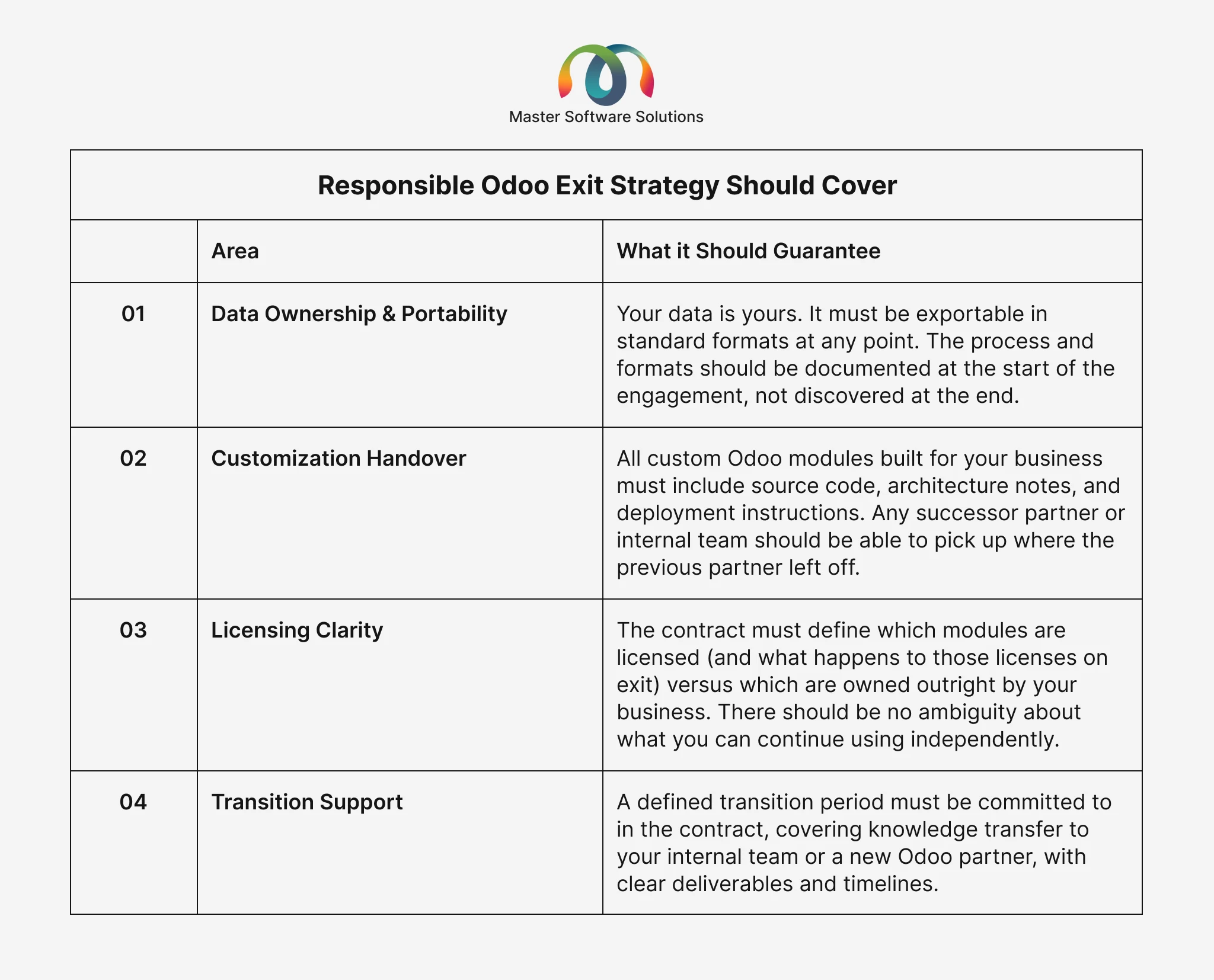
Any engagement contract that does not address all four of these areas is incomplete. You should request that each be explicitly covered before you sign.
Reviewing an Odoo implementation contract?
Ask us to walk you through what a complete exit framework looks like and what to flag if it’s missing from the agreement you’re about to sign. Talk to Our Team
Our Exit Strategy at Master Software Solutions
At Master Software Solutions, every client engagement includes a documented exit strategy from day one. We raise this topic ourselves, in our first detailed conversation with every client, because we believe it is a mark of professional confidence, not a sign of doubt.
Our exit framework covers both directions: a client choosing to move on and circumstances that might require us to transition a client to another Odoo partner. Both are handled the same way with structure, transparency, and a commitment to making the handover as smooth as possible.
Data Ownership and Portability
Your data belongs to you. Full stop. We document the exact export process and file formats at the start of every engagement and not when you need them. Your Odoo data is exportable in standard formats, and we make sure you know exactly how to access it at any point.
Customisation Handover
Every custom Odoo module we build for your business is fully documented. This includes source code, architecture notes, and step-by-step deployment instructions. When we write custom code for your Odoo environment, we write it as though another competent partner will eventually need to maintain it because they might.
No black boxes. No dependency on institutional knowledge that only lives in our team’s heads. Any qualified Odoo partner can take over your environment and get up to speed quickly.
Licensing Clarity
We define licensing terms clearly in every contract. You will know from the outset which components are licensed and subject to ongoing terms and which are outright owned by your business. There are no hidden dependencies or surprises on exit.
Transition Support
We commit to a defined transition period in every engagement contract. This covers knowledge transfer to your internal team or a new partner, documentation handover, and a structured exit process with agreed timelines and deliverables. You will not be left in the dark during a transition.
We bring this conversation up first. If you are speaking to Odoo partners who have not raised the exit strategy with you, it is worth asking them why — and what their answer tells you about how they operate.
Signs of a Partner You Can Trust With Your Long-Term Odoo Investment
The exit strategy conversation is one of the clearest signals of how mature and client-focused an Odoo implementation partner is. Here is what to look for:
They raise exit terms without being asked.
Confidence in the quality of their work means they are not afraid of this conversation.
Exit terms are in the contract, not a verbal promise
Anything agreed upon verbally is unenforceable. If it is not in writing, it does not exist.
Data portability is documented at the start
Not on request, not when you’re trying to leave at the very beginning of the project.
Custom code is written to be handed over
Documentation is a deliverable, not an afterthought.
Licensing is explained in plain language
You should never have to guess what you own versus what you have access to.
A transition period is committed to contractually
The length and scope of transition support should be defined, not left open-ended.
If a partner cannot tick every one of these boxes, you are taking on unnecessary risk, risk that only becomes visible after you have made a commitment that is very difficult to undo.
Wondering if your current Odoo contract has these protections?
Speak to our team. We will help you understand what to look for and how to strengthen your position before you sign. Request a Contract Review Consultation
The Questions You Should Ask Every Odoo Partner About Exit
Use this list in your partner evaluation conversations. These questions are direct, reasonable, and entirely professional. A strong partner will answer every one without hesitation.
- Is there a documented exit strategy included in your standard engagement contract?
- In what formats can I export my Odoo data, and how is that process documented?
- Who owns the custom Odoo modules built for my business?
- What documentation will be provided for custom code, such as source code, architecture notes, deployment instructions?
- Which components are licensed versus owned outright by me?
- What happens to licenses and access rights if the engagement ends?
- What does the transition support period look like, and what is it committed to in the contract?
- Have you ever transitioned a client to another Odoo partner? How did that work?
Any partner who is reluctant to answer these questions clearly is telling you something important about how they operate and what it might feel like to try to leave them.
An exit plan is one part of a well-run project; our complete Odoo ERP implementation guide covers the rest.
Frequently Asked Questions
Q1. Do all Odoo implementation partners include an exit strategy in their contracts?
A1. No. Many do not. Exit terms are often omitted from standard implementation contracts because they are uncomfortable to discuss and, frankly, some partners prefer the dependency they create. This is exactly why you should ask for them explicitly before signing — and why we include them in every engagement without being asked.
Q2. Who owns the custom Odoo modules built for my business?
A2. This depends entirely on how your contract is written. At Master Software Solutions, custom modules built specifically for your business are owned by you. We document this clearly in the engagement contract so there is no ambiguity. If a partner’s contract does not address IP ownership of customizations, ask for it to be added before you sign.
Q3. What does “data portability” actually mean in practice for Odoo?
A3. It means your business data, including customers, transactions, inventory, HR records, and financial history, can be exported from Odoo in standard formats that can be imported into another system or handed to another partner. We document the exact formats and process at the start of every engagement so you have that information on hand, not just when you need it urgently.
Q4. What happens to our Odoo environment if Master Software Solutions is acquired or changes focus?
A4. Our exit framework covers both directions. If circumstances on our side require a transition, we commit to the same structured handover process: full data export documentation, custom module handover with source code and architecture notes, and a defined transition support period. Our clients are never left exposed by changes on our end.
Q5. How long is the transition support period?
A5. The length of the transition period is defined in the engagement contract and depends on the complexity of the implementation. For straightforward deployments, a short structured handover may be sufficient. For complex, heavily customized Odoo environments, a longer transition period with more extensive knowledge transfer is appropriate. The specifics are agreed upon contractually, not left open-ended.
Q6. Is raising the exit strategy a sign that a partner expects the relationship to fail?
A6. Not at all. It is the opposite. Partners who raise exit terms upfront are demonstrating that they are confident enough in their work and their conduct to make those commitments in writing. It is the same reason a professional services firm puts its terms clearly in a contract: not because it expects conflict, but because clarity prevents it.
Q7. What if I want to bring Odoo management in-house after the initial implementation?
A7. This is one of the most common transition scenarios, and our exit framework is designed to support it. We provide full documentation of your Odoo environment, custom modules, and operational processes so your internal team can take over with confidence. We can also offer a structured knowledge transfer program to upskill your team before the handover date.