The dairy processing business is unforgiving. Thin margins, a perishable product, strict quality regulations, and complex supplier networks leave almost no room for guesswork. Yet many dairy businesses still rely on disconnected spreadsheets, phone calls, and manual logs to manage critical operations, from procurement to dispatch.
The result? Milk gets rejected at the gate because no one tracked quality trends. Procurement costs spike because no one noticed a supplier’s price creep. A cold chain excursion goes undetected until a buyer sends back an entire consignment.
Odoo Dairy ERP is built to eliminate these blind spots. By consolidating procurement, quality, processing, inventory, logistics, and finance into one platform, it gives dairy owners and managers live visibility into the KPIs that actually drive profitability, from the moment milk arrives at the collection point to the moment it reaches the customer.
In this blog, we walk through the most critical KPIs across every stage of your dairy value chain and show you exactly how Odoo Dairy ERP surfaces and automates these metrics.
Why KPIs are Non-Negotiable in Dairy Processing
Dairy processing is a game of margins measured in fractions of a rupee per liter. A 1.5% increase in procurement cost, a rejected batch due to missed quality checks, or a delivery delay that triggers buyer penalties, each of these individually can wipe out an entire day’s profit. Together, they can sink a business.
KPIs, Key Performance Indicators, are the early warning system that prevents these situations. They turn operational data into actionable signals. Without them, you’re reacting. With them, you’re in control.
The problem most dairy businesses face isn’t a lack of data; it’s a lack of connected data. Procurement records live in one system, quality test results in another, and dispatch logs in a third. Odoo Dairy ERP pulls all of this into a single platform, so every KPI is automatically calculated from the same source of truth in real time.
“In dairy processing, the difference between a profitable operation and a loss-making one often isn’t scale; it’s visibility.”
Book a personalized demo with our Odoo Dairy ERP specialists. We’ll show you exactly how your procurement-to-delivery data translates into dashboards that drive smarter, faster decisions every single day.
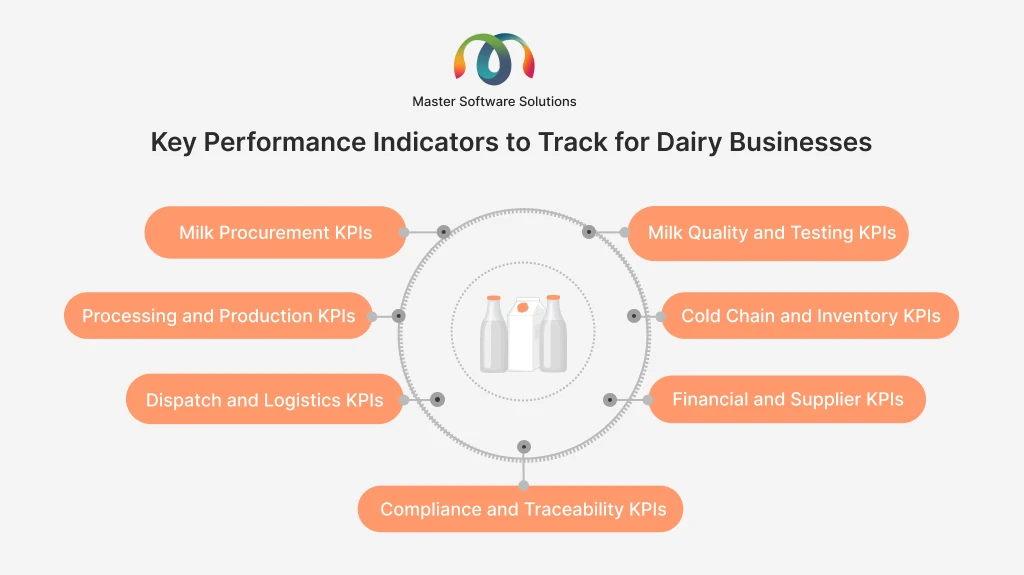
Milk Procurement KPIs
Procurement is where your costs are set, and your supply reliability is determined. These KPIs tell you whether you’re buying the right volume at the right price from the right suppliers, and whether your procurement process is lean or leaky.
Milk Procurement Volume vs. Target
This KPI compares the actual milk volume procured daily, weekly, or monthly against your planned procurement target. Consistent shortfalls signal supplier reliability issues, route coverage gaps, or seasonal pressures that need pre-emptive action.
- Track by route, collection centre, and supplier category
- Shortfalls below 90% of the target should trigger immediate supplier engagement
- Seasonal dip patterns should inform buffer stock and pricing strategies
In the Odoo dairy ERP, Procurement receipts are entered per route and supplier. Live dashboards display actual vs. planned volume in real-time, with color-coded alerts for shortfall thresholds.
Average Procurement Price Per Litre
Your procurement price per liter is your single largest input cost. Tracking its movement across suppliers, routes, and time periods allows you to spot price creep early, benchmark supplier rates, and protect your processing margin.
- Calculate as a blended average across all suppliers and routes
- Compare against your realised selling price to monitor gross margin
- Flag suppliers whose rates consistently exceed the blended average
In the Odoo dairy enterprise resource planning platform, every procurement captures supplier, volume, and price. The system automatically calculates the blended procurement rate per liter and tracks price trends over configurable periods.
Milk Rejection Rate at Procurement
Not all milk that arrives passes quality inspection. The rejection rate at the procurement gate indicates the percentage of incoming milk that is turned away due to adulteration, excess acidity, temperature excursion, or failed platform tests.
- Target below 2% rejection across all procurement points
- Track by supplier, route, and rejection reasons separately
- High rejection rates from specific suppliers warrant a contract review or delisting
In Odoo ERP for dairy manufacturers, quality checks at receipt are linked directly to procurement records. Rejected lots are logged with reason codes. Supplier rejection rate reports are automatically generated for review.
Supplier Reliability rate
This KPI measures the percentage of times each supplier delivers within the committed volume range and time window. Unreliable suppliers create planning chaos. Disrupt processing schedules and force costly last-minute procurement from spot markets.
- Target 95%+ on-time, on-volume deliveries per active supplier
- Score suppliers monthly to inform the contract renewals and bonus schemes
- Combine it with the rejection rate to build a composite supplier scorecard.
In the Odoo dairy ERP, expected vs. actual delivery records are tracked per supplier. The system generates supplier scorecards that combine volume reliability, punctuality, and quality-rejection data.
Also Read: Batch Processing in Dairy Manufacturing: How Dairy ERP System Manages Production
Milk Quality and Testing KPIs
Quality isn’t just a compliance requirement; it directly determines your pricing, your buyer relationships, and your ability to sell premium products. These KPIs track the quality of milk flowing through your plant and flag issues before they become costly rejections or recalls.
Average Fat and SNF (Solid Non-fat) Content
The fat and SNF percentages determine the suppliers’ price and the price you charge customers. Most markets price milk by components. A consistent 0.2% drop in fat content can significantly erode both procurement value and sales realisation.
- Track as a daily and weekly rolling average by procurement route and supplier
- Typical fat targets are 3.5-4.2%, and SNF targets are 8.3-8.7%
- Persistent low composition from specific routes indicates adulteration or poor practices
In Odoo ERP for the dairy industry, lab and milk-tester results are entered for the lot at receipt. The system plots fat and SNF trends over time per supplier and route and automatically calculates value-adjusted procurement pricing.
Total Bacterial Count (TBC) / Total Plate Count (TPC)
TBC is a direct measure of milk hygiene from collection to receipt. High bacterial counts shorten shelf life, increase the risk of spoilage during processing, and can trigger regulatory penalties or buyer rejections. It is a leading indicator of upstream cold chain failures.
- Regulatory guidelines are below 200,000 CFU/ml for Grade A raw milk
- Rising TBC from a route usually signals a broken cold chain at collection
- Should be tested on every incoming batch, not just sampled periodically
In the Odoo dairy ERP, TBC results are logged per lot and linked to the procurement record. Threshold breaches trigger automatic quality alerts and place the lot on hold pending review.
Adulterated Detection Rate
Water addition, neutralizer usage, and synthetic solids are among the common adulterations in dairy supply chains. Tracking the detection rate at incoming quality checks and by supplier protects your product quality and strengthens your supplier accountability program.
- Target: 0% adulterated milk accepted into processing
- Track detection rate separately from rejection rate; some adulterations are caught post-acceptance
- Repeat offenders must be flagged, penalised, or delisted under your supplier policy
In Odoo ERP for dairy businesses, platform test results, including CLR, acidity, added water, and neutralizers, are captured per lot. Adulteration flags are linked to supplier records and visible on the procurement scorecard.
Incoming Milk Temperature Compliance Rate
Milk that arrives above the acceptable temperature threshold (typically above 10°C) has already begun bacterial proliferation. Tracking temperature compliance at the receiving dock identifies which routes and vehicles have cold chain failures before the problem reaches processing.
- Acceptable incoming temperature should be ≤10°C (ideally ≤7°C for extended shelf-life products)
- Target 100% of incoming lots within temperature specification
- Non-compliant lots should be quarantined and tested before processing decisions are made
With Odoo dairy ERP, the temperature is recorded per lot at receipt. Excursions automatically trigger a quarantine status, generate a non-conformance record, and alert the quality supervisor.
Odoo Dairy ERP’s built-in quality control module captures every test result, flags every non-conformance, and keeps you audit-ready without a single manual report. Stop chasing lab results in notebooks; get them in your dashboard the moment they’re recorded.
Processing and Production KPIs
Your processing plant is where raw milk becomes a sellable product. These KPIs ensure that your plant runs efficiently, converting milk at maximum yield, and producing to specification with minimal waste or downtime.
Plant Utilization Rate
Plant utilization measures how much of your installed processing capacity you are using. Under-utilization inflates your fixed cost per liter, whereas over-utilization strains equipment, increasing maintenance frequency, and risks product quality.
- Optimal range: 75-90% of rated capacity for most dairy processing lines
- Track by shift, production line, and product category
- Continuous under-utilizing capacity signals procurement shortfalls or demand planning gaps.
- Track by shift, production line, and product category
- Persistent under-utilization signals procurement shortfalls or demand planning gaps
In the Odoo dairy ERP, production orders capture actual vs. planned processing volumes per line. Utilization reports are automatically generated by day, week, or month, with drill-down to identify root causes.
Processing Loss / Yield Variance
Processing loss is the difference between the volume of raw milk that enters your plant and the total volume of finished product (including by-products). Even a 0.5% higher loss than industry norms translates into significant financial leakage at scale.
- Scale acceptance processing loss should be 1-3% based on the product type
- Track by product line, shift, and batch to isolate sources of high loss
- Losses should be categorized based on evaporation, spills, CIP rinse, and quality rejects
In the dairy manufacturing Oddo ERP, raw material consumption and finished goods output are recorded per production order. Yield variance is automatically calculated per batch and flagged when it exceeds configured tolerance thresholds.
Equipment Downtime Rate
Unplanned downtime in a dairy plant is extremely costly. Milk is perishable and cannot wait for the pasteurizer to be repaired. Tracking downtime by equipment and cause enables predictive maintenance planning and eliminates the most expensive breakdowns.
- Target total unplanned downtime below 2% of scheduled production hours
- Classify downtime as mechanical, electrical, CIP, changeover, and operator errors
- Recurring downtime on specific equipment signals the end-of-life or maintenance gaps
In the Odoo ERP, equipment downtime is logged via maintenance work orders linked to production schedules. The system calculates downtime as a percentage of scheduled hours and tracks equipment reliability over time.
Cost of Production Per Litre / Per SKU
This is the most important financial KPI in your processing operation. It tells you exactly what it costs in raw milk, packaging, utilities, labor, and overhead to produce every liter of the finished product. Without this, you cannot price confidently or negotiate with buyers from a position of strength.
- Calculate production separately for each SKU (full cream, toned, double toned, paneer, etc.)
- Compare against your realised selling price per SKU to calculate true gross margin
- Monitor monthly trends to catch cost inflation before it erodes profitability
In the Odoo ERP, the manufacturing and accounting modules together allocate all direct and indirect costs to each production batch. Cost per liter per SKU is updated automatically with every procurement, payroll, and utility entry.
Most dairy plants consider an average processing loss of 2–4% “acceptable.” But plants that actively track and optimize this KPI routinely bring it below 1.5%, saving lakhs of rupees per month at even modest production volumes.
Cold Chain and Inventory KPIs
For any perishable product, the cold chain is a critical control point. A single temperature excursion can compromise an entire storage tank. These KPIs ensure your inventory is safe, your cold chain is intact, and your working capital isn’t tied up in slow-moving stock.
Cold Chain Compliance Rate (Storage)
This KPI tracks what percentage of the time your milk tanks, finished goods chillers, and cold rooms maintain the required temperature. Even brief excursions above threshold, especially in bulk storage, can accelerate spoilage across the entire holding.
- Pasteurised milk storage: maintain ≤4°C at all times
- Target: 100% compliance; zero excursions are the only acceptable goal
- Any excursion must be investigated, documented, and closed with root cause analysis
In the Odoo Dairy ERP, IoT temperature sensor integrations continuously log readings. Excursions above threshold trigger instant alerts, auto-generate non-conformance records, and link to the affected inventory lot.
Inventory Turnover Rate & Days-to-Expiry at Dispatch
In dairy, inventory that doesn’t move quickly becomes unsaleable. Inventory turnover rate tells you how efficiently you’re selling finished goods. Days-to-expiry at dispatch tells you whether your customers are receiving products with adequate shelf life, which directly impacts returns, complaints, and reorder frequency.
- Target: inventory turnover ratio of 8–12× per month for fresh milk products
- Dispatch products with a minimum of 50–60% of shelf life remaining
- FEFO (First Expired, First Out) picking must be enforced, not just recommended
In Odoo Dairy ERP, lot-level expiry dates are tracked throughout the warehouse. FEFO picking is enforced automatically during order fulfillment. Expiry risk reports identify slow-moving lots before they become write-offs.
Finished Goods Wastage / Write Off Rate
Every unit of finished product that expires in your warehouse or is returned unsaleable represents a 100% sunk cost, as procurement, processing, packaging, and storage have already been paid. Tracking write-off rates by SKU and reason helps you eliminate the most costly sources of finished goods loss.
- Target: write-off rate below 0.5% of total finished goods produced
- Categorise losses: expired, quality failure, damage, returned goods
- Rising write-offs for a specific SKU signal a demand planning or distribution problem
In Odoo Dairy ERP, write-offs are recorded against specific lots with reason codes. The system calculates the financial impact of each write-off and generates monthly loss summaries by SKU and category.
Odoo Dairy ERP’s real-time inventory management and IoT-connected cold-chain monitoring will notify you the moment a temperature excursion occurs, rather than when the batch is returned. Protect your product, your margins, and your buyer relationships. Get a Free Operations Assessment
Dispatch and Logistics KPIs
In dairy, distribution is the last mile of quality assurance. A perfect product leaving your plant can change into a customer complaint if your logistics KPIs are unchecked. These metrics keep your delivery operations sharp and your buyer relationships intact.
On-Time Delivery Rate (OTDR)
OTDR measures the percentage of deliveries that reach the customer within the committed time window. For dairy products, a late delivery isn’t just a service failure; it reduces the useful shelf life at the point of sale and can trigger buyer penalties or listing risks at organized retail.
Target: 98%+ on-time delivery across all routes and customer types
Track by route, vehicle, driver, and customer segment separately
Persistent delays on specific routes require vehicle, driver, or route redesign
In Odoo Dairy ERP, delivery orders are generated from sales orders with committed delivery windows. Actual delivery times are recorded and compared automatically. OTDR is reported by route, driver, and customer segment.
Customer Return & Complaint Rate
Returns and complaints are the most visible quality failures. By the time a customer returns the product, the damage to the relationship has already begun. Tracking return rates by reason and by customer channel helps you fix problems at their source rather than apologizing for them repeatedly.
- Target: return rate below 0.3% of units dispatched
- Classify returns: quality, short expiry, delivery damage, quantity discrepancy
- Each return should trigger a credit note, root cause investigation, and preventive action
In Odoo Dairy ERP, customer returns are processed as reverse receipts linked to the original delivery. Return reasons are captured and analyzed. Credit notes are generated automatically and linked to the customer’s account.
Vehicle Utilization & Delivery Cost Per Route
Running half-empty vehicles or over-routing your fleet inflates your distribution cost per liter, one of the most controllable cost lines in a dairy business. Vehicle utilization and cost-per-route KPIs tell you where to consolidate, reschedule, or renegotiate transport contracts.
- Target vehicle load factor: above 80% of capacity per trip
- Calculate the delivery cost per litre per route to identify loss-making routes
- Benchmark third-party transporter rates against in-house fleet costs quarterly
In Odoo Dairy ERP, Delivery orders are assigned to vehicles with load tracking. Fuel, driver, and maintenance costs are allocated per trip. Cost-per-route reports help you optimize fleet deployment and identify inefficient routes.
Financial and Supplier KPIs
Financial KPIs tie together everything upstream. They reveal whether your margins are holding, your cash cycle is healthy, and your supplier and customer relationships are financially sustainable.
Gross Margin Per SKU
Not all dairy products are equally profitable. Full cream milk, toned milk, butter, paneer, and flavored drinks all have different cost structures and market realizations. Tracking gross margin per SKU helps you focus production and sales effort on your most profitable products and deprioritize or reprice the rest.
- Formula: (Net Selling Price – Cost of Production) ÷ Net Selling Price × 100
- Track monthly trends: a product with a shrinking margin may need repricing or reformulation
- Use margin data to drive sales team incentive structures and route-to-market decisions
In Odoo Dairy ERP, sales and manufacturing data are combined to produce margin reports based on product and customer channel. Management dashboards display gross margin trends by SKU, with drill-down into cost component breakdowns.
Accounts Receivable Ageing
Dairy businesses often supply distributors, retailers, and institutions on credit. When receivables age, especially beyond 60 days, they create cash flow gaps that affect your ability to pay suppliers, meet payroll, and fund procurement. AR aging is one of the most important liquidity indicators in the business.
- Classify invoices into 0–30, 31–60, 61–90, and 90+ day buckets
- Automate payment reminders at 7, 14, and 30 days overdue
- Flag customers with persistent 60+ day balances for credit limit review
In Odoo Dairy ERP, the Accounting module provides a real-time AR aging report by customer. Aging thresholds trigger automated email reminders. Credit limits block new orders for customers in breach.
Supplier Payment Cycle Time
Dairy farmers and collection agents depend on timely payments to maintain their operations. Late supplier payments erode trust, reduce supply reliability, and can cause suppliers to divert milk to competitors. Tracking your payment cycle time and keeping it consistent is a competitive retention tool, not just a financial metric.
- Target: pay all milk suppliers within the contractually agreed cycle (often 10–15 days)
- Delays beyond the agreed cycle should be flagged and escalated immediately
- Automated payment runs eliminate processing delays caused by manual approvals
In Odoo Dairy ERP, supplier invoices are auto-generated from procurement receipts. Payment run schedules are configured per supplier group. The system tracks payment cycle time and flags delays against contracted terms.
Compliance and Traceability KPIs
Regulatory compliance in dairy is not optional, and the cost of a compliance failure goes far beyond the fine. These KPIs ensure your documentation is complete, your audits are stress-free, and your products can be traced and recalled within minutes if needed.
Lot Traceability Completeness Rate
Can you trace the product’s batch in minutes, from the procurement receipt and quality test results to the production batch, storage location, and then the specific delivery note and customer invoice? Regulators, retailers, and export buyers increasingly require this. Incomplete traceability during an inspection or recall can result in suspension of production.
- Target: 100% lot traceability completeness for all finished goods dispatched
- Upstream: procurement lot, quality test results, processing batch, storage tank
- Downstream: finished goods lot, delivery note, invoice, customer, return status
Odoo Dairy ERP provides full bi-directional lot traceability built into every module. A single lot number surfaces the complete chain, from supplier delivery to customer invoice, on one screen, in seconds.
Non-Conformance (NC) Closure Rate & Open NC Aging
With every quality failure, including a temperature excursion, a failed lab test, or a customer complaint, a Non-Conformance (NC) record should be created citing the root cause, corrective action, and closure date. Open NCs that age beyond their due date signal a quality management system that is reactive and not preventive.
- Target: 100% of critical NCs closed within 7 days of opening
- Track NC ageing by category: supplier, process, product, customer, regulatory
- Recurring NCs in the same category indicate systemic failure requiring process change
In Odoo Dairy ERP, NC records are generated from quality checks, stating the assigned owners and due dates. Overdue NCs trigger automatic escalation to the quality manager. Closure rates are reported on the quality KPI dashboard.
Regulatory Document Compliance Rate
FSSAI licenses, HACCP documentation, product label compliance, testing certificates, and supplier quality agreements all have renewal deadlines and mandatory update cycles. Letting any of these lapse, even accidentally, can halt operations, suspend licenses, or trigger buyer de-listing.
- Track every regulatory document with its expiry date and the responsible owner
- Set renewal alerts at 90, 60, and 30 days before expiry
- Target: zero lapsed compliance documents at any point in the year
In Odoo Dairy ERP, compliance documents are stored with expiry dates and ownership in the document management module. Automated renewal reminders are sent to responsible staff and escalated to management if unacted upon.
Odoo Dairy ERP keeps your compliance documentation current, your lot traceability complete, and your non-conformance records closed, so when FSSAI or a retailer auditor walks through your door, you’re confident, not scrambling. Let us show you what audit-readiness looks like in practice. Book a Compliance Audit
How Odoo Brings it All Together
Tracking KPIs in isolation is only half the battle. The real power of Odoo Dairy ERP is that every metric feeds from the same data. A procurement rejection automatically updates your supplier scorecard. A cold chain excursion links to the affected lot and the downstream delivery. A high AR balance triggers a credit hold before the next order ships. Every role in your business gets a dashboard built for what they need to see and act on:
- Procurement Manager: Volume vs. target, procurement price trends, supplier rejection, and reliability scores.
- Quality Manager: Fat/SNF trends, TBC results, cold chain logs, open NCs, and audit document status.
- Plant Manager: Utilization rate, processing yield variance, equipment downtime, and production order status
- Logistics head: OTDR by route, vehicle load factor, delivery cost per route, return rates
- Finance Director: Cost per liter per SKU, gross margin by product, AR aging, supplier payment cycle
- Owner / MD: P&L summary, top KPI scorecard, compliance status, month-on-month growth
All views. Same data. Updated in real time. No Monday morning reports. No waiting for finance to run the numbers. Just the truth, when you need it. From the first liter procured to the last invoice paid, Odoo Dairy ERP gives you complete visibility, control, and confidence. Our team will have you live in weeks, with your real data, your workflows, and your KPIs front and centre.
Master Software Solutions: Your Trusted Odoo Partner for the Dairy Industry
Master Software Solutions is a specialized Odoo implementation partner with deep, hands-on expertise in dairy and agri-food ERP. We understand the business of dairy from the inside, including seasonal procurement swings, multi-supplier payment complexity, the unforgiving nature of perishable inventory, and the relentless scrutiny of food safety regulators.
Our team of certified Odoo consultants and dairy industry specialists has helped dairy processors, cooperatives, distributors, and private labels build digital operations that are transparent, traceable, and continuously improving. We don’t implement generic ERP; we implement dairy ERP, designed around the way your business actually works.
Whether you’re a regional dairy processor looking to replace spreadsheets or a large multi-plant operation seeking end-to-end integration, we bring the domain knowledge, technical depth, and implementation rigor to get you live and get you results.
Tell us where you are today: spreadsheets, legacy software, or a disconnected patchwork of tools, and we’ll show you exactly what a connected, KPI-driven dairy operation looks like on Odoo. First conversation is free, and so is the coffee. Schedule Your Free Consultation
Frequently Asked Questions (FAQs)
Q1. What is Odoo Dairy ERP, and how is it different from a standard ERP system?
A1. Odoo Dairy ERP is a purpose-configured implementation of the Odoo open-source ERP platform, built around the specific workflows and data requirements of dairy processing businesses. Unlike standard ERP systems, which treat dairy as just another manufacturing vertical.
Our implementation includes dairy-specific modules: milk procurement management with quality testing at receipt, lot-level cold chain tracking, component-based pricing (fat/SNF), supplier scorecards, FEFO inventory management, and full bi-directional lot traceability from procurement to customer delivery. You get a system that understands your language from day one.
Q2. Which KPIs are available out of the box, and which require additional configuration?
A2. The majority of KPIs covered in this blog, including procurement volume vs. target, procurement price per liter, quality rejection rates, cold chain compliance, processing yield variance, on-time delivery rate, AR aging, gross margin per SKU, and lot traceability, are available out of the box within our Odoo Dairy ERP package.
Some advanced custom KPIs, such as route-specific cost per liter, breed-specific composition benchmarks, or integration with third-party lab information systems (LIMS), may require light configuration, which our team handles as part of the implementation scope.
Q3. Can Odoo Dairy ERP integrate with our existing milk testing equipment or IoT cold chain sensors?
A3. Yes. Odoo supports REST API and webhook integrations with most modern milk quality analyzers (Milko-testers, infrared analyzers), cold chain IoT platforms, and data loggers from leading manufacturers. Temperature sensors, milk volume meters, and weigh bridges can all feed data directly into Odoo, eliminating manual entry and ensuring your quality and cold chain KPIs are always current. Our technical team assesses integration compatibility during the pre-implementation scoping phase at no additional charge.
Q4. How long does implementation typically take for a dairy processing business?
A4. For a single-plant dairy processor with standard procurement, processing, and distribution workflows, our implementation typically takes 6–10 weeks from kickoff to go-live. For multi-plant operations, complex integrations, or businesses requiring significant data migration from legacy systems, timelines typically range from 12 to 20 weeks. We use an agile, phased approach, so you start getting value from core modules like procurement and quality management before the full system is live.
Q5. Is Odoo Dairy ERP suitable for small dairy operations?
A5. Odoo Dairy ERP scales from small regional processors handling 5,000 liters per day to large multi-plant operations managing several lakh liters daily. We offer tiered pricing based on the number of users and active modules, making it financially accessible for small businesses. In fact, some of our fastest and most dramatic ROI stories come from small processors who moved from notebook-and-Excel operations to fully digital systems; the productivity and loss-reduction gains are immediate and measurable.
Q6. What ongoing support does Master Software Solutions provide after the system goes live?
A6. We offer tiered Annual Maintenance Contracts (AMC) that include a dedicated helpdesk, bug resolution, minor enhancements, Odoo version upgrades, and regular account review calls. Our average response time for business-critical issues is under 4 hours during business hours. For clients who want continuous improvement, such as new reports, additional module rollouts, or workflow refinements, we offer monthly retainer packages. Our goal is to be a long-term digital operations partner for your dairy business, not a one-time implementer.