For most dairy businesses, packaging materials aren’t just containers; they’re capital. Crates, bottles, pallets, and returnable assets represent thousands of rupees in circulation at any given moment. Yet most dairies still track them with tally sheets, phone calls, and gut feel.
Walk into any mid-sized dairy distribution hub, and you’ll find a familiar problem: crates going out in counts of 500 and coming back in counts of 471. Nobody knows where the other 29 are. The delivery driver says he returned them all. The retailer says they never got that many. And the accounts team has no way to enforce the deposit.
This isn’t a people problem; it’s a systems problem. And Odoo ERP, configured for dairy operations, solves it at the root.
The hidden scale of packaging losses in dairy
Before exploring solutions, it helps to understand the size of the problem. Industry data paints a clear picture of the stake for dairy operations that rely on manual tracking.
- 4-8% of returnable packaging stock is lost annually in manually managed dairy operations
- $13K+ average annual packaging write-off for dairy running 10,000 crates.
- 3.5 days spent per month on manual returnable reconciliation across routes
- 60% of deposit disputes arise from missing digital records, not actual discrepancies.
The Real Cost of Untracked Returnable Packaging
Walk into any dairy distribution hub, and you’ll find a familiar scene: 500 crates go out, 471 come back. Nobody can account for the missing 29. The delivery driver swears he returned them all. The retailer claims they never received that many. And without a system, you have no way to enforce the deposit or investigate the discrepancy.
Industry data suggest dairy businesses lose 4–8% of their returnable packaging stock annually due to untracked losses. For a company running 10,000 crates in circulation, that is hundreds of units per year; real capital is written off due to poor visibility.
Why Manual Tracking Fails at Scale
Tally sheets and phone calls work when you have 5 retailers. At 50 or 500, the system collapses. Returns get logged on the wrong customer. Deposits get credited without a physical return. Reconciliation takes days. The errors compound month after month until a physical count reveals a gap nobody can explain.
Is your dairy business bleeding packaging capital without knowing it? Our ERP consultants work exclusively with dairy operations. In a free 30-minute session, we’ll map your current packaging flow, identify your biggest loss points, and show you exactly what a structured Odoo setup would look like for your scale. Book an Audit
How Odoo ERP Creates a Closed-Loop Returnable System
When configured for dairy operations, Odoo’s inventory and sales modules create end-to-end traceability for every returnable asset, from the moment it leaves your warehouse to the moment it returns.
Product-Level Tracking For Every Packaging Type
Each packaging type, such as crates, glass bottles, plastic crates, and pallets, is set up as a separate product in Odoo with its own stock location and movement history. You always know exactly how many units are at each customer location, in transit, or back at your warehouse.
Deposit Management Built into Sales Orders
When a retailer receives 100 crates, Odoo automatically applies the deposit amount on the invoice. When crates are returned, a reverse stock transfer and credit note are triggered automatically. This removes manual entry and disputes. Every transaction has a digital paper trail that both parties can reference.
Customer-Wise Returnable Balances
Every distributor and retailer has a live running balance in Odoo. Before any delivery or collection run, your team can pull a real-time report showing exactly who has how many units outstanding and flag accounts that are overdue on returns before dispatching more.
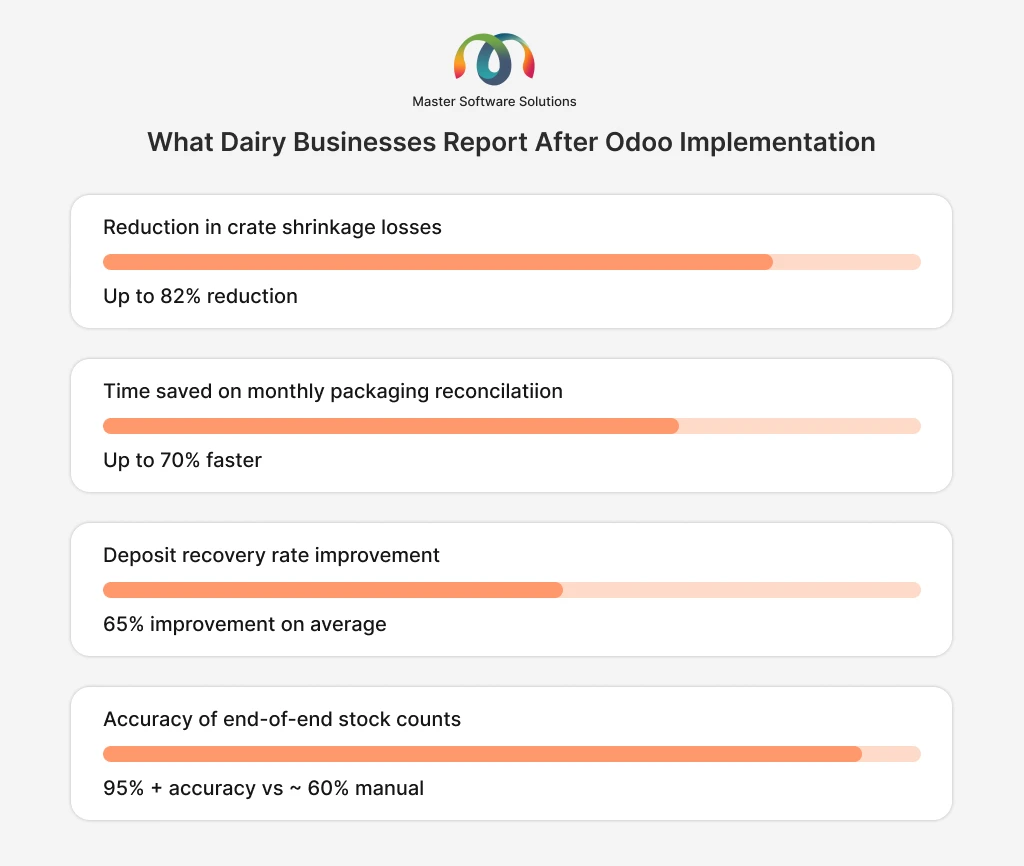
One dairy client reduced deposit disputes by over 60% within the first billing cycle after going live on Odoo, simply because both parties now had access to the same digital record.
Route-Based Return Scheduling and Driver Reconciliation
One of the most overlooked inefficiencies in dairy distribution is the return trip. Drivers often complete deliveries but forget to collect returns, or collect them but log the counts incorrectly. Odoo fixes this at the workflow level.
Outbound and Return Quantities on the Same Delivery Order
Odoo’s delivery routes can be configured to include expected return quantities alongside drop quantities on every delivery order. The driver sees both on their mobile interface. When they scan and confirm the return, the system updates inventory and the customer’s balance simultaneously.
Damaged Packaging as a Separate Stock Location
Returned crates or bottles that arrive damaged are logged into a quarantine or scrap location, keeping your usable inventory count accurate and creating a clear record for insurance or supplier warranty claims. Nothing disappears into a grey area.
Not every dairy operation is the same; your distribution model, route density, and packaging mix all affect how Odoo should be configured. We have implemented returnable tracking for dairies ranging from 50 to 2,000+ routes. Book a Meeting with Our Dairy Experts
How Odoo Helps in Smarter Procurement of Primary Packaging Materials
Beyond returnables, dairy operations deal with high-volume primary packaging, including pouches, cartons, lids, labels, and film rolls. Teams typically over-order out of fear of a stockout or under-order and halt production lines. Neither is acceptable.
Packaging Consumption Linked to Production Orders
Odoo’s Manufacturing module directly connects packaging consumption to production planning. When a batch of 2,000 liters of flavored milk is scheduled, Odoo automatically calculates how many 500ml pouches, batch stickers, and shrink-wrap units are needed and checks current stock against reorder points.
Automated Reorder and Vendor Comparison
Minimum order quantity rules, supplier lead time buffers, and multi-vendor price comparison are all configured at the product level. When the stock drops below the threshold, Odoo automatically generates an RFQ. Your purchase manager reviews and approves; the system does the rest.
No more halting a production run because someone forgot to reorder pouches. And no more overpaying because the team couldn’t see what was already in transit from the supplier.
Reporting and Accountability Across the Supply Chain
Data is only useful if it is visible to the right people at the right time. Odoo’s reporting layer gives dairy operations a clear picture of packaging health at every level.
Outstanding Returnable Balance Report
A single report shows all customers with pending returnable balances, such as how many units, since when, and the deposit value at stake. This is a powerful tool for your accounts and collections team, especially at month-end.
Loss Trend Analysis
Over time, Odoo tracks shrinkage patterns by route, by driver, and by customer. If one distributor consistently returns fewer crates than they receive, the data surfaces that pattern, enabling a proactive conversation before losses accumulate.
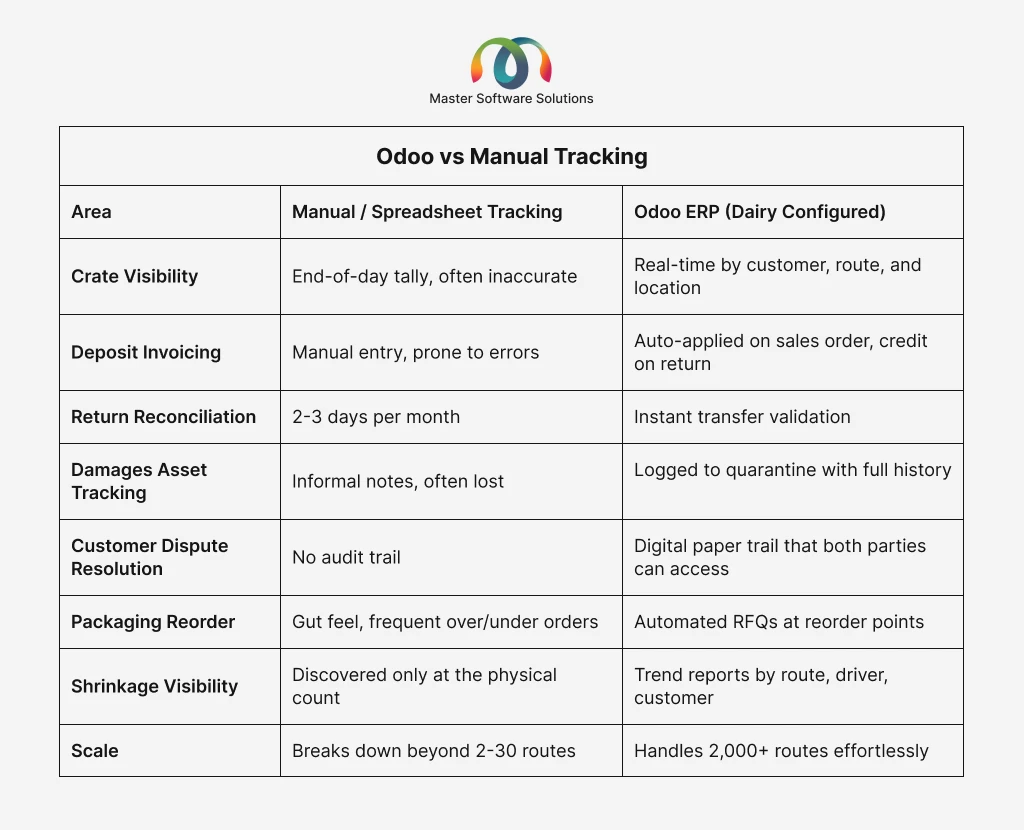
Odoo vs Manual Tracking: A Direct Comparison
Still confused whether a dedicated ERP is worth the investment? Here is how Odoo stacks up against the manual approach across the metrics that matter most to dairy operations.
Step-by-Step: How a Crate Return Works in Odoo
Here is the exact workflow a dairy operation follows when a retailer returns crates, from dispatch to credit note, entirely within Odoo.
1. Delivery order created with crate quantity
When a sales order is confirmed, Odoo automatically generates a delivery order list with both the product quantity and the number of crates being dispatched. The deposit amount is added to the invoice.
2. Driver confirms dispatch via mobile interface
The delivery driver scans or confirms the crate count on the Odoo mobile app at the point of delivery. Stock moves from the warehouse to the customer location in real time. 3 Return transfer created on collection day
When the driver visits the retailer for the next delivery, a return transfer is opened on the app showing the expected return quantity. The driver enters the actual count received.
4. Damaged crates are routed to quarantine
Any crates flagged as damaged during return are moved to a quarantine stock location instead of back into usable inventory. The quality team reviews and decides whether to repair, scrap, or file a warranty claim.
5. Credit note auto-generated for the returned quantity
On transfer validation, Odoo creates a credit note for the deposit value of returned crates. Partial returns generate partial credits. Customer’s outstanding balance updates instantly.
6. Balance report available to both parties
The retailer can view their outstanding crate balance and transaction history via the customer portal. Your accounts team sees the same data. Disputes drop sharply.
Real-World Example: Regional Dairy With 300 Routes
How did a mid-sized dairy cut packaging losses by 78% in one quarter?
A regional dairy cooperative operating 300 delivery routes across two states was writing off approximately ₹18 lakh per year for unrecovered crates and bottles. Their accounts team spent four days every month on manual reconciliation, and customer disputes over deposits were a weekly occurrence.
After implementing Odoo with dairy-specific configuration, including per-customer crate balances, deposit automation, and driver mobile confirmation, the results within the first 90 days were significant.
- 78% reduction in unrecovered packaging
- 4 days to 3 hours of monthly reconciliation time save
- $15k in annual deposit recovery recovered
Our dairy experts will walk you through a fully configured dairy Odoo instance: creating a delivery with crates, generating the deposit invoice, processing a partial return, flagging damaged packaging, and pulling the outstanding balance report.
Dairy Odoo ERP Implementation: What to Expect
Setting up returnable packaging management in Odoo requires upfront structured configuration for product types, deposit rules, return routes, and stock locations. For most dairy operations, this takes 2–4 weeks with an experienced implementation partner.
The key decisions to nail early:
- Will you track crates by batch or serial number?
- Will deposits be invoiced separately or embedded in the product price?
- Which packaging items need expiry date tracking?
Getting these right at setup prevents costly rework later. Most clients begin seeing measurable returns in reduced write-offs and reconciliation time within their first billing cycle after go-live.
Glossary of Key Terms
New to dairy ERP or returnable logistics? Here are the terms used throughout this article and across the industry.
Returnable Packaging: Reusable containers, including crates, bottles, and pallets, are dispatched to customers with the expectation of return after use.
Deposit Management: A financial mechanism where customers pay a refundable fee per packaging unit, recovered upon return.
Crate Reconciliation: The process of matching dispatched crate quantities against returned quantities to identify losses or discrepancies.
Stock Location: A defined physical or virtual storage area in Odoo, e.g., warehouse, vehicle, customer site, and quarantine.
Return Transfer: An Odoo inventory operation that moves stock from a customer location back to the warehouse, triggering a credit note.
Reorder Point: A minimum stock threshold at which Odoo automatically generates a purchase order or request for quotation.
Bill of Materials (BoM): A list of all components, including packaging, required to produce a finished dairy product in Odoo manufacturing.
Shrinkage: The gap between expected and actual packaging stock, caused by losses, theft, damage, or recording errors.
Conclusion
Returnable packaging management is one of the highest-ROI improvements a dairy business can make and one of the most neglected. With Odoo ERP, you get a system that tracks every crate and bottle, automates deposit invoicing, schedules return pickups, and gives you real-time visibility across your entire network.
Master Software Solutions is an end-to-end Odoo implementation company specializing in dairy ERP. From initial consultation and system design to going live, training, and ongoing support, our Odoo Implementation team brings deep expertise in dairy-specific workflows, such as crate tracking, route management, milk billing, cold chain compliance, and more.
Talk to a specialist about your packaging, billing, and distribution challenges. We’ll assess your current setup and show you what Odoo can do. Get a Free Dairy ERP Consultation
Frequently Asked Questions
Q1. Can Odoo track crates at the individual unit levels or only in bulk quantities?
A1. Odoo supports both. You can track crates in bulk quantities (e.g., 100 crates dispatched to retailer X) or by individual serial numbers if your operation requires that level of granularity. Serial tracking is common for high-value assets like stainless steel crates or specialized cold-chain containers. For most dairy operations, lot/batch tracking is sufficient and much easier to manage operationally.
Q2. How does Odoo handle deposit invoicing when a customer only partially returns crates?
A2. Odoo handles partial returns natively. When a return transfer is validated, for example, 30 out of 70 crates are returned and validated, the system automatically generates a credit note for 30 crates. The remaining 40 are visible on the customer’s outstanding balance. You can set up alerts so your accounts team is notified when a balance exceeds a certain number of days or units.
Q4. Does this work for multi-depot dairy operations where crates move between locations?
A4. Yes, Odoo’s multi-warehouse and inter-company transfer features are well-suited to multi-depot dairy operations. You can define stock locations for each depot, transfer crates between them with a digital transfer order, and maintain a consolidated view of packaging stock across all locations in real-time. Each depot can have its own reporting or roll into a central dashboard.
Q5. How long does implementation typically take for mid-sized dairy operations?
A5. For a dairy operation with 50-200 delivery routes and standard crates, a 5k+ bottle tracking requirements, implementation typically takes 3-6 weeks from kickoff to go-live. This includes configuration, data migration, driver app training, and a parallel-run period where both systems operate simultaneously to validate accuracy. Larger or more complex operations, including multiple depots, serialized tracking, and custom deposit structures, may take 8-12 weeks.
Q6. Can distributors or retailers view their returnable balance without logging into Odoo?
A6. Yes, through the Odoo customer’s portal. Distributors and retailers can log in to a branded portal to see their outstanding crate balance, view transaction history, and download statements without requiring an internal Odoo licence. This dramatically reduces disputes because customers can verify their own records at any time rather than waiting for your team to send a statement.
Q7. What happens to damaged crates in the system? Are they written off automatically?
A7. Damaged returns are moved to a dedicated quarantine or scrap location rather than being automatically written off. Your quantity or operations teams then review them; some may be repairable and returned to stock, others permanently scrapped. The system creates an audit trail for each damaged item, which is useful for insurance claims and for identifying if certain routes or customers are causing disproportionate damage.