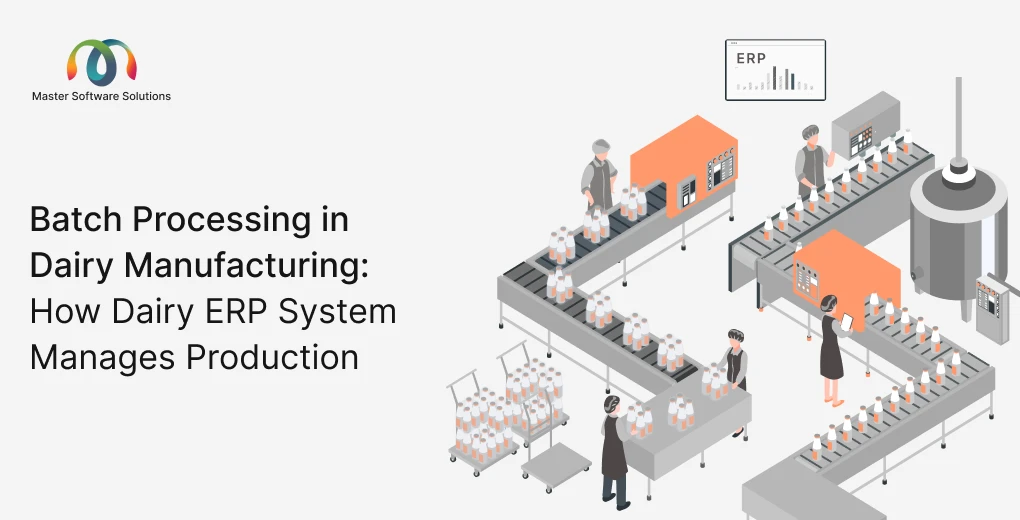
As a dairy CEO, you already know how tight the margins are in this industry. Raw milk prices fluctuate, regulatory requirements tighten, and consumer expectations for quality and transparency continue to rise.
In this environment, operational excellence isn’t a competitive advantage; it’s a survival requirement. And one of the most powerful levers available to dairy leaders who are serious about operational excellence is their ability to manage batch processing.
Batch processing sits at the very core of dairy production. Whether you’re running a fresh milk plant, a cheese-aging facility, a yogurt fermentation line, or a multi-product dairy operation, every unit of finished product begins its life as a batch, a discrete, traceable, controllable production event. How you manage those batches determines your yield, your compliance posture, your recall readiness, and ultimately, your profitability.
This is where a modern Dairy ERP (Enterprise Resource Planning) system changes the game. For businesses ready to move beyond fragmented systems and manual processes, the right ERP doesn’t just digitize batch records; it transforms batch production into a strategic growth engine.
What is Batch Processing in Dairy Manufacturing?
Before exploring how ERP transforms it, it’s worth grounding the conversation in what batch processing in dairy actually means at an operational level.
Batch processing is the production of goods in defined, discrete quantities, called batches, each governed by a specific recipe, a set of raw material inputs, and a series of controlled process steps. In dairy manufacturing, a batch might be a 10,000-liter run of pasteurized whole milk, a 500-kilogram production of salted butter, a fermentation vat of Greek yogurt, or a run of individually portioned UHT cream packs.
Every batch is assigned a unique identifier and documented from start to finish: what went in, the process it went through, what quality checks were applied, what came out, and where it went. This documentation isn’t optional; it’s the foundation of food safety compliance, quality assurance, and the kind of traceability that regulators and retail customers now demand as a baseline.
The challenge for dairy operations of any scale is that managing this documentation and coordination manually, or with disconnected systems, creates real operational and financial risk. The larger the operation, the greater that risk.
The Hidden Cost of Disconnected Batch Management
For many dairy businesses, batch management is still handled through a patchwork of approaches: paper-based batch records, spreadsheet-driven scheduling, standalone laboratory systems, and phone calls between production and procurement. CEOs often underestimate the cost of this disconnection.
Consider these scenarios:
Scenario 1:
A retailer flags a quality issue on a batch of flavored yogurt. Your team spends three days manually tracing records across departments to determine which raw material lot was involved and which other products may have been affected. By the time you have a clear picture, the retailer has already pulled product from shelves, and the reputational damage is done.
Scenario 2:
A production scheduler builds next week’s plan based on spreadsheet data, unaware that a key ingredient is on back order. Midway through a critical batch run, production halts. The downtime ripples through your cold chain, and perishable raw materials that were already committed to the batch are wasted.
Scenario 3:
Your annual audit requires compiling pasteurization time-temperature logs, supplier certification records, allergen checks, and operator sign-off documentation from across your facility. The process takes weeks and pulls your quality team away from their primary responsibilities.
These are not edge cases. They are the predictable consequences of batch management systems that weren’t designed to keep pace with the complexity of modern dairy operations. This leads to waste, downtime, compliance exposure, and management time, affecting your bottom line.
Want to find out what disconnected batch management is costing your operations? Request a free operational assessment from our Dairy ERP specialist today.
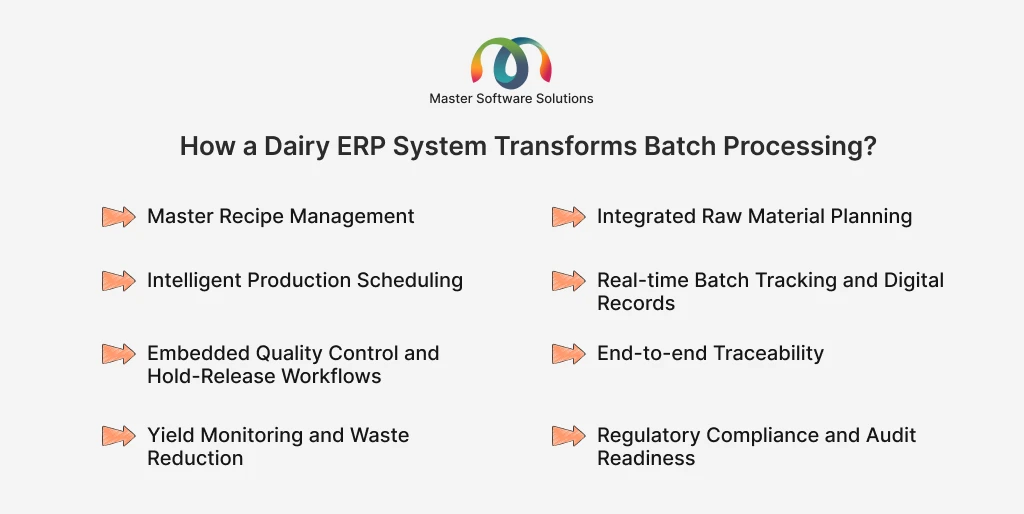
How a Dairy ERP System Transforms Batch Processing?
A purpose-built Dairy ERP system replaces this patchwork with a unified, intelligent platform that manages every dimension of batch production, from the moment a production order is created to the moment finished goods leave your facility. Here’s what that looks like in practice.
Master Recipe Management
Every batch begins with a recipe. In a modern Dairy ERP system, recipes are stored as controlled master documents that specify exact ingredient quantities, processing parameters, process sequence, critical control points, and expected yields. When a production order is created, the system automatically generates a batch production record (BPR) populated directly from the approved master recipe.
For dairy CEOs overseeing multi-site operations or a broad product portfolio, this centralization is transformative. It ensures that a block of cheddar or any other product produced at one facility and an identical block produced at another are made to the same specification. It eliminates the operator-to-operator variation that erodes product consistency. And it gives your R&D and quality teams a version-controlled environment where recipe changes are tested, approved, and pushed to the production floor, without risk of outdated instructions circulating on the shop floor.
Integrated Raw Material Planning
A Dairy ERP system connects batch production directly to inventory and procurement. Before a batch run is authorized, the system checks real-time raw material availability and then reserves the required quantities across all inputs, including milk, cream, cultures, flavorings, stabilizers, and packaging, and validates that ingredient lots meet specifications and haven’t exceeded shelf life.
If any input falls short, the system triggers an alert to procurement or suggests an adjusted production schedule before the gap becomes a production crisis. This proactive planning reduces waste, prevents costly mid-run stoppages, and ensures that your procurement team is always working with accurate demand signals from the production floor rather than best-guess estimates.
Intelligent Production Scheduling
Dairy operations involve significant scheduling complexity. Pasteurizers, homogenizers, culture tanks, aging rooms, and filling lines must be coordinated carefully. Equipment must be cleaned between runs. Perishable raw inputs have narrow windows for use. Downstream cold storage and dispatch schedules impose further constraints.
A Dairy ERP system provides a dynamic production scheduler that accounts for all of these variables simultaneously, including equipment capacity, CIP (Clean-in-Place) cycles, minimum and maximum batch sizes, raw material shelf life, labor availability by shift, and finished goods storage capacity. The result is an optimized, conflict-free production plan that maximizes throughput, minimizes downtime, and sequences batches to reduce cross-contamination risk between allergen-containing and allergen-free product lines.
For CEOs who have struggled with production plans that fall apart in execution, this is one of the most immediately visible improvements a Dairy ERP delivers.
Real-time Batch Tracking and Digital Records
As a batch moves through production, the ERP captures data at every stage, including ingredient additions, process temperatures, durations, equipment readings, and operator sign-offs. This creates a real-time, digital batch record that replaces paper logs and provides live visibility to supervisors, quality managers, and plant leadership.
Where ERP systems are integrated with IoT sensors, SCADA, or PLC systems on the plant floor, this data capture happens automatically, pulling time-temperature logs from pasteurizers, pH readings from fermentation tanks, and weight data from filling stations directly into the batch record. This eliminates manual data entry, reduces human error, and means your batch records are always complete, timestamped, and tamper-evident.
For dairy CEOs who have invested in smart manufacturing infrastructure, a Dairy ERP system is the platform that turns that data into actionable business intelligence.
Embedded Quality Control and Hold-Release Workflows
Quality control in dairy manufacturing is not a post-production event; it runs continuously through every stage of a batch. A Dairy ERP system embeds QC checkpoints directly into the batch workflow, triggering sampling requests and test requirements at the right moment, capturing lab results against the batch record, and enforcing hold-and-release logic that prevents a batch from advancing until defined quality criteria are confirmed.
This is particularly critical for fermented products like yogurt, cultured cream, and cheese, where fermentation outcomes must be verified before the batch proceeds to filling or pressing. It is equally important for products subject to HACCP critical control points, where deviation from a critical limit must trigger an immediate response and not a manual review hours later.
For CEOs focused on minimizing quality escapes and the cost of rework or finished goods disposal, embedded QC workflows represent a significant operational and financial improvement.
Curious how a Dairy ERP can cut your quality-related production losses? Book a personalized demo and see the quality management module in action.
Also Read: Top 10 ERP Software for the Dairy Businesses
End-to-end Traceability
This is where a Dairy ERP system delivers one of its most strategically important capabilities and one that directly addresses one of the highest-stakes risks in dairy manufacturing: the product recall.
A modern Dairy ERP provides complete forward and backward traceability across every batch. Forward traceability shows you which finished goods were produced from a given raw material lot and exactly which customers received them. Backward traceability shows you every ingredient, supplier, and process step that contributed to a given finished batch.
In a recall scenario, whether triggered by a quality complaint, a contamination finding, or a supplier notification, this traceability allows your team to execute a targeted, evidence-based response within hours. Rather than broad precautionary recalls that damage customer relationships and erode margin, you can isolate exactly what needs to be withdrawn and demonstrate to regulators exactly what was done and why.
Beyond recall readiness, this traceability supports the growing demand from major retail and foodservice customers for supply chain transparency. As farm-to-fork documentation becomes a standard commercial requirement, dairy businesses with robust ERP-driven traceability have a clear advantage in retailer negotiations and new business development.
Yield Monitoring and Waste Reduction
Yield is the ratio of finished product output to raw input consumed. It is one of the most important financial metrics in dairy manufacturing. Even small improvements in yield across high-volume product lines translate directly into significant margin improvement at scale.
A Dairy ERP system tracks actual yield against standard yield for every batch run and surfaces variances automatically. Over time, this data provides a clear analytical foundation for continuous improvement:
- Which product lines consistently underperform on yield?
- Which equipment or process steps are the greatest sources of loss?
- How does yield vary across shifts, operators, or raw material suppliers?
For dairy CEOs who feel they are leaving margin on the table but lack the data to quantify or address it, yield analytics within an ERP system is often one of the highest-return capabilities available.
Regulatory Compliance and Audit Readiness
The dairy industry operates under one of the most demanding regulatory frameworks in food manufacturing, spanning food safety standards like HACCP, FSMA, and ISO 22000, dairy-specific regulations on pasteurization and labeling, and an increasing volume of retailer-mandated audit schemes.
A Dairy ERP system maintains a complete, structured, auditable record of every batch, from milk receipt documentation and supplier certifications through in-process controls and finished goods distribution. When a regulator requests records or a third-party audit is scheduled, your team can retrieve comprehensive, timestamped documentation in minutes rather than days.
The system can also enforce compliance-critical workflows automatically, for example, ensuring that allergen declaration checks are completed before a batch is released or that pasteurization time-temperature records are captured within system-defined parameters. This moves compliance from a reactive documentation exercise to a proactive, embedded operational discipline.
Ready to transform your compliance posture? Talk to our team about how our Dairy ERP helps manufacturers stay audit-ready every day of the year.
How Does a Dairy ERP System Add Value to the Business? : A CEO Perspective
The operational capabilities of a Dairy ERP system are significant. But as a CEO, your focus is on business outcomes. Here is what dairy manufacturers consistently report after implementing a purpose-built ERP for batch production management:
Improved Margin Through Yield Gains
Systematic yield monitoring and root cause analysis typically deliver 2–5% improvement in raw material utilization across product lines, which is a meaningful impact on gross margin in a low-margin industry.
Reduced Quality-Related Losses
Embedded QC workflows and real-time batch monitoring reduce finished goods holds, rework events, and product disposals, often delivering six-figure savings in larger operations.
Faster Recall Execution
End-to-end traceability reduces the time required to scope and execute a recall from days to hours, limiting both the financial cost and reputational damage of a quality incident.
Lower compliance overhead
Automated documentation and audit-ready records reduce the man-hours required to prepare for and navigate regulatory or third-party audits, freeing quality and operations teams for value-adding work.
Scalable growth infrastructure
As your business grows, with new product lines, new facilities, co-manufacturing relationships, and export markets, a Dairy ERP provides the infrastructure to scale batch production management without proportional growth in administrative overhead.
For dairy CEOs evaluating capital allocation decisions, the return profile of a well-implemented Dairy ERP system is consistently strong, with payback periods typically ranging from 18 to 36 months and long-term operational benefits that compound as the business grows.
What to Look for in a Dairy ERP System?
Not all ERP systems are built for the complexity of dairy manufacturing. Generic ERP platforms often require significant customization to handle dairy-specific requirements like variable composition milk intake, fat and protein accounting, culture and aging management, and cold chain logistics. This customization adds cost, extends implementation timelines, and creates maintenance risk over time.
When evaluating Dairy ERP solutions, dairy CEOs should prioritize platforms that offer
- Native batch genealogy and lot traceability without custom development
- Dairy-specific recipe and formula management, including variable yield and composition accounting
- Integration with plant-floor systems, such as SCADA, MES, and LIMS, for automated data capture
- Built-in regulatory compliance workflows aligned with HACCP, FSMA, and relevant national standards
- Cold chain and shelf-life management across raw materials and finished goods
- Scalable multi-site architecture for businesses with growth ambitions
Equally important is the implementation partner. Look for vendors with demonstrated dairy industry expertise, a proven implementation methodology, and a long-term commitment to product development that keeps pace with regulatory changes and industry evolution.
Conclusion
The dairy industry is not getting simpler. Input cost volatility, tightening food safety regulations, rising retailer expectations, and increasing consumer demand for transparency are all structural trends that will continue to intensify. In this environment, the operational foundation of your business matters enormously.
Batch processing is not a back-office function; it is the core of what your business produces and sells. Managing it with precision, visibility, and intelligence is a strategic capability that differentiates high-performing dairy businesses from those that struggle with waste, compliance risk, and operational fragility.
A purpose-built Dairy ERP system gives you that capability. It puts real-time data at the center of every batch decision, embeds quality and compliance into every production workflow, and provides the end-to-end traceability that protects your business when things go wrong and accelerates your growth when things go right.
The dairy leaders who invest in this infrastructure today will be better positioned to compete, scale, and win in the years ahead.
Take the next step for your dairy operation. Whether you’re evaluating ERP for the first time or looking to replace a system that’s holding your business back, our team is ready to help. Schedule a CEO briefing to explore how a Dairy ERP system can be tailored to your production environment, your compliance requirements, and your growth objectives.
Frequently Asked Questions
Q1. What is a Dairy ERP system, and how is it different from a generic ERP?
A1. A Dairy ERP system is an enterprise resource planning platform specifically designed for the operational requirements of dairy manufacturing.
Unlike generic ERP solutions, a Dairy ERP includes native support for dairy-specific processes such as milk intake, composition accounting (fat, protein, somatic cell count), variable yield management, culture and fermentation tracking, cold chain logistics, aging and maturation scheduling, and regulatory compliance frameworks.
Generic ERP systems can often be customized to handle some of these requirements, but the cost, complexity, and ongoing maintenance of that customization typically far outweigh the benefits of using a purpose-built solution.
Q2. How does a Dairy ERP system support food safety and regulatory compliance?
A2. A Dairy ERP embeds compliance directly into production workflows rather than treating it as a separate documentation task. It enforces HACCP critical control point monitoring, captures pasteurization time-temperature records automatically, manages allergen declaration checks before batch release, and maintains a complete, auditable trail of every production event.
When auditors arrive, whether from a regulatory body or a retail customer, your team can retrieve structured, timestamped batch records in minutes. The system also supports certification schemes such as ISO 22000, BRC, and SQF, and can be configured to align with regional dairy regulations.
Q3. How long does it take to implement a Dairy ERP system?
A3. Implementation timelines vary based on the size and complexity of your operation, the number of sites, the degree of integration with existing plant-floor systems, and the extent of data migration required. For mid-sized dairy manufacturers, a phased implementation typically takes between six and twelve months.
Larger, multi-site operations may require twelve to twenty-four months for full deployment. Working with an experienced Dairy ERP implementation partner significantly reduces risk and timeline. Most reputable vendors offer a phased rollout approach, prioritizing the highest-impact modules such as batch management and traceability first, so your operation begins realizing value well before the full system is live.
Q4. Can a Dairy ERP system integrate with our existing plant-floor equipment and systems?
A4. Yes. Modern Dairy ERP systems are designed to integrate with a wide range of plant-floor technologies, including SCADA (Supervisory Control and Data Acquisition) systems, PLCs (Programmable Logic Controllers), MES (Manufacturing Execution Systems), and LIMS (Laboratory Information Management Systems). These integrations allow the ERP to capture process data, temperatures, pressures, flow rates, and weights automatically from equipment, eliminating manual data entry and ensuring that batch records are always complete and accurate. Before selecting a Dairy ERP, it is important to confirm that the platform has documented integration capabilities with the specific equipment and software your facility already uses.
Q5. What is the typical return on investment (ROI) for a Dairy ERP implementation?
A5. ROI varies by operation, but dairy manufacturers commonly report measurable returns across several dimensions: raw material yield improvements of 2–5%, reductions in quality-related losses and product disposals, significant reductions in compliance and audit preparation costs, and faster, more targeted recall execution that limits financial exposure.
When these benefits are aggregated across a full production operation, payback periods typically range from 18 to 36 months. Beyond the direct financial returns, the strategic value of improved traceability, compliance posture, and scalability positions the business for stronger growth and more favorable relationships with major retail and foodservice customers.
Q6. Is a Dairy ERP system suitable for small and mid-sized dairy businesses or only for large enterprises?
A6. Dairy ERP solutions are available across a wide range of scales and price points. While large enterprise deployments with full multi-site integration and IoT connectivity represent one end of the spectrum, there are purpose-built platforms well-suited to small and mid-sized dairy operations, including artisan cheesemakers, regional fluid milk processors, and independent yogurt manufacturers.
For smaller businesses, cloud-based Dairy ERP solutions offer the benefits of centralized batch management and traceability without the infrastructure investment of on-premise systems. The key is selecting a platform that is scalable, one that meets your current needs while having the capacity to grow with your business.
Q7. How does a Dairy ERP system help during a product recall?
A7. During a recall, speed and precision are everything. A Dairy ERP system provides complete forward and backward lot traceability, meaning your team can instantly identify which raw material lots contributed to an affected batch, which other finished products may have been impacted, and exactly which customers received those products.
This targeted visibility enables a precise, evidence-based recall response rather than a broad precautionary withdrawal. What might previously have taken days of manual record searching can be completed within hours, dramatically limiting the financial cost, the scope of customer disruption, and the reputational damage associated with a quality incident.
Q8. What should dairy CEOs prioritize when evaluating Dairy ERP vendors?
A8. Beyond core functionality, dairy CEOs should evaluate vendors on four key dimensions.
First, industry specificity: does the platform include native dairy manufacturing capabilities, or will significant customization be required?
Second, integration depth: can the system connect seamlessly with your existing plant floor, laboratory, and logistics systems?
Third, implementation expertise: does the vendor have a proven track record of successful dairy ERP deployments, and do they understand the unique regulatory and operational context of your markets?
Fourth, long-term partnership: does the vendor have a credible product roadmap, active investment in R&D, and a commitment to keeping the platform current with evolving regulatory requirements?
A Dairy ERP is a long-term strategic investment, and the vendor relationship matters as much as the software itself.
Still have questions? Speak with one of our Dairy ERP specialists; we’re happy to answer your specific questions and help you evaluate whether our platform is the right fit for your operation.