Production planning plays a critical role in dairy manufacturing. The industry operates under constant pressure. Products are highly perishable. Demand changes frequently. Raw milk supply varies in both quality and quantity. At the same time, manufacturers must meet strict food safety and regulatory standards.
In this environment, even small planning errors can have serious consequences. Poor planning can lead to excess waste, stockouts, missed delivery commitments, or compliance risks. Accurate production planning helps dairy manufacturers balance demand, capacity, inventory, and shelf life. It ensures that the right products are made, in the right quantities, at the right time.
This is where dairy ERP solutions become essential. A dairy ERP provides integrated planning, real-time visibility, and data-driven decision-making. It connects demand forecasts, production schedules, inventory, quality, and compliance in a single system.
With the right dairy ERP system, dairy manufacturers can move from reactive planning to controlled and efficient operations.
Table of Contents
Characteristics of dairy production planning
Dairy production planning differs from other manufacturing industries. It requires constant coordination between supply, production, quality, and distribution. The following characteristics make planning especially complex.
Short shelf life
Dairy products spoil quickly. Milk, yogurt, cheese, and cream have limited shelf lives. This puts strong time pressure on production planning. Manufacturers must align production closely with demand. Overproduction leads to waste. Underproduction leads to missed orders and lost revenue. Planning must also consider expiry dates while scheduling, storing, and dispatching. Even a one-day delay can reduce product value.
Perishable raw materials
Raw milk is highly perishable. It must be processed within a limited time after collection. Storage options are limited and costly. Production planners must act fast. They need to decide which products to produce based on current milk availability, demand priorities, and plant capacity. Any disruption, such as transport delays or quality issues, can affect the entire production plan.
Variable milk supply
Milk supply is not consistent. It can change due to seasonality, weather, animal health, and farming practices. This variability makes planning difficult. Some days may have an excess supply. Other days may fall short. Planners must adjust production schedules frequently. They also need to manage surplus milk by diverting it to a suitable product with a longer shelf life, such as powder or cheese.
Quality variations
Milk quality varies by fat content, protein levels, and bacterial count. These factors directly affect yield and product suitability. Production planning must consider milk composition. Not all milk can be used for all products. Poor quality milk may require reprocessing or rejection. Without proper planning tools, this leads to inefficiencies and higher losses.
Multiple product variants
Dairy manufacturers produce many product types. This includes different fat levels, flavours, pack sizes, and packaging formats. Each variant has its own recipe, process time, and resource needs. Managing hundreds of SKUs increases planning complexity. Frequent changeovers also reduce equipment efficiency. Planners must sequence production carefully to minimize downtime and waste.
Strict compliance requirements
Dairy manufacturing is highly regulated. Food safety, quality standards, and traceability are mandatory. Every batch must be documented. Ingredients, processing steps, test results, and dispatch details must be traceable. Planning must account for quality checks, approvals, and holds. Any failure can lead to recalls, penalties, or brand damage.
Key production planning challenges in dairy manufacturing
Dairy production planning is complex and time-sensitive. Manufacturers must balance demand, capacity, quality, and compliance every day. The following difficulties define the core planning risks in dairy operations.
Demand forecasting uncertainty
Demand for dairy products changes frequently. Seasonality, consumer preferences, weather, and retail promotions all affect sales volumes. Private-label commitments and short-notice promotions increase unpredictability. Planners must adjust schedules to meet changing demand. Inaccurate forecasts lead to overproduction, excess inventory, or missed delivery commitments. This directly impacts revenue, service levels, and customer trust.
Shelf-life-driven inventory risk
Dairy products have a limited shelf life. Overproduction results in spoilage and write-offs. Underproduction leads to stockouts and lost sales. Production planning must consider both quantity and timing. Products must be manufactured, stored, and dispatched within stric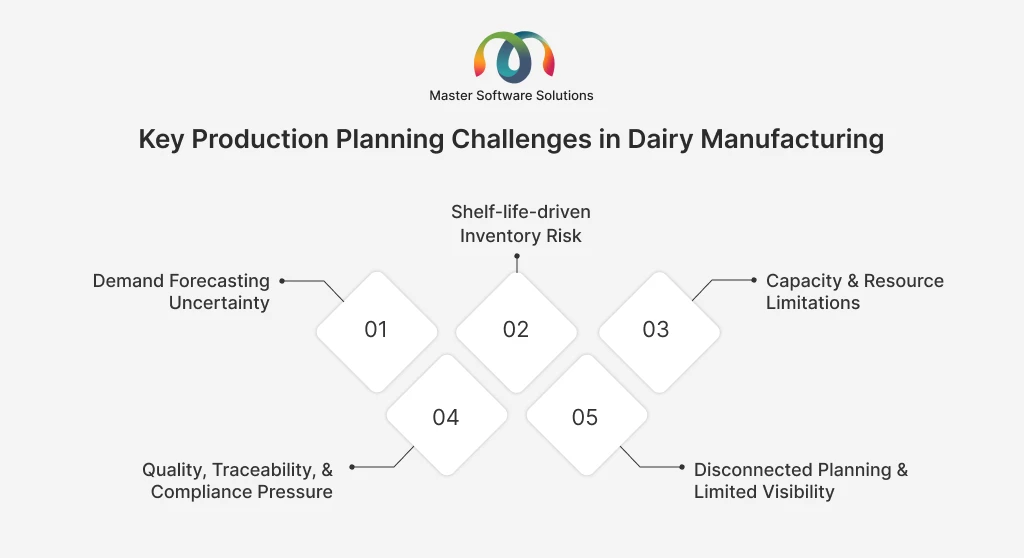 t expiry windows. Without shelf-life-aware planning, inventory quickly becomes a financial liability.
Capacity and resource limitations
Dairy manufacturing depends on specialized equipment, skilled labor, and strict hygiene processes. Production lines require frequent cleaning and sanitation cycles, reducing availability capacity. Labor availability varies by shift and season. Poor coordination between resources and schedules leads to idle equipment, overtime costs, or rushed production. This reduces efficiency and increases operational risk.
Quality, traceability, and compliance pressure
Dairy manufacturing is highly regulated. Every batch must be traceable from raw milk intake to delivery of finished goods. Planning must account for quality checks, test results, approvals, and potential holds. If an issue occurs, affected batches must be identified quickly. Weak traceability slows recalls, increases compliance risk, and exposes the business to reputational damage.
Disconnected planning and limited visibility
Many dairy manufacturing businesses still rely on spreadsheets and disconnected systems. Data is often outdated, incomplete, or inconsistent. This limits real-time visibility into production status, inventory levels, and quality conditions. Planners are forced to react instead of plan proactively. As operations scale, manual planning becomes unsustainable and error-prone.
Limitations of traditional planning approaches
Traditional production planning methods are no longer sufficient for dairy manufacturing. They lack flexibility, speed, and accuracy in a fast-changing operating environment. Here are the limitations of traditional planning approaches.
Static planning models
Traditional planning relies heavily on fixed plans and historical data. These plans are usually created weekly or monthly and remain unchanged until the next planning cycle. In dairy manufacturing, conditions change daily. Milk supply fluctuates. Demand shifts quickly. Static plans cannot adapt to these changes. As a result, planners are forced to rely on manual adjustments, which increases errors and reduces planning accuracy.
Delayed decision-making
Traditional systems do not provide real-time data. Information is often spread across spreadsheets, emails, and disconnected systems. Planners spend significant time collecting and validating data before making decisions. By the time decisions are made, the data may already be outdated. This delay leads to missed opportunities, inefficient production runs, and higher operational costs.
Limited response to disruptions
Dairy operations face frequent disruptions. These include supply shortages, sudden changes in demand, equipment breakdowns, and quality failures. Traditional planning tools offer little support for rapid re-planning. Scenario analysis is manual and time-consuming. As a result, manufacturers react slowly to disruptions, increasing the risk of waste, service failures, and compliance issues.
How does dairy ERP address production planning challenges?
A dairy ERP system is designed to manage the unique complexity of dairy manufacturing. It replaces fragmented planning with integrated, data-driven control across demand, production, quality, and compliance. Here are the ways the dairy ERP system addresses production planning challenges.
Integrated demand and production planning
A dairy ERP software connects demand forecasts directly to production plans. Sales forecasts, customer orders, and historical data flow into a single planning model. This alignment ensures planning volumes reflect real market demand. Planners can simulate multiple scenarios, such as demand spikes or supply shortages, and evaluate their impact before executing changes. This reduces last-minute schedule changes and improves planning accuracy.
Shelf-life-aware inventory control
Dairy ERP systems manage inventory based on expiry dates, not just quantities. They apply First-expire, First-out (FEFO) logic to ensure older stock is used and shipped first. Production scheduling also considers shelf life. Products are planned to match delivery timelines and market demand. This reduces spoilage, improves inventory rotation, and minimizes waste across the dairy supply chain.
Real-time production visibility
A dairy ERP integrates live data from the shop floor, including production progress, yield, and downtime. Planners gain immediate visibility into actual performance versus the plan. The system highlights exceptions such as delays, shortages, or quality deviations. This allows teams to take corrective action early, rather than reacting after problems escalate.
Optimized capacity and scheduling
Dairy ERP systems optimize the use of equipment, production lines, and labor. They factor in progressing times, line constraints, and changeover requirements. Cleaning-in-place (CIP) cycles and planned downtime are built into the schedule. This prevents overloading resources and improves overall equipment efficiency. The result is a smoother production flow and better use of available capacity.
Automated quality and traceability
Dairy ERP solutions provide end-to-end traceability, from raw milk collection to finished goods dispatch. Every batch is automatically linked to ingredients (BoM), processes, and quality results. Quality checks, approvals, and holds are embedded into the production workflow. In the event of a recall or audit, affected batches can be identified quickly and accurately. This reduces compliance risk, recall costs, and operational disruptions.
Business benefits of ERP-driven production planning
ERP-driven production planning enables dairy manufacturers to operate with greater control, accuracy, and agility. It directly impacts cost, service, and operational performance. Here are the business benefits of dairy ERP-driven production planning.
Reduced waste and spoilage
An ERP system aligns production volumes with actual demand and shelf-life constraints. It considers expiry dates, inventory levels, and demand forecasts when creating production plans. This prevents unnecessary overproduction and ensures products are used and dispatched within their usable life. Expiry-based inventory management improves stock rotation and reduces write-offs. As a result, manufacturers significantly lower waste and spoilage while improving sustainability.
Improved service levels and OTIF performance
ERP-driven planning integrates sales orders, forecasts, production schedules, and inventory availability into one system. This alignment ensures products are produced and delivered on time and in full. Fewer last-minute changes are required, and order fulfillment becomes more predictable. Consistent OTIF performance strengthens customer trust and improves long-term commercial relationships.
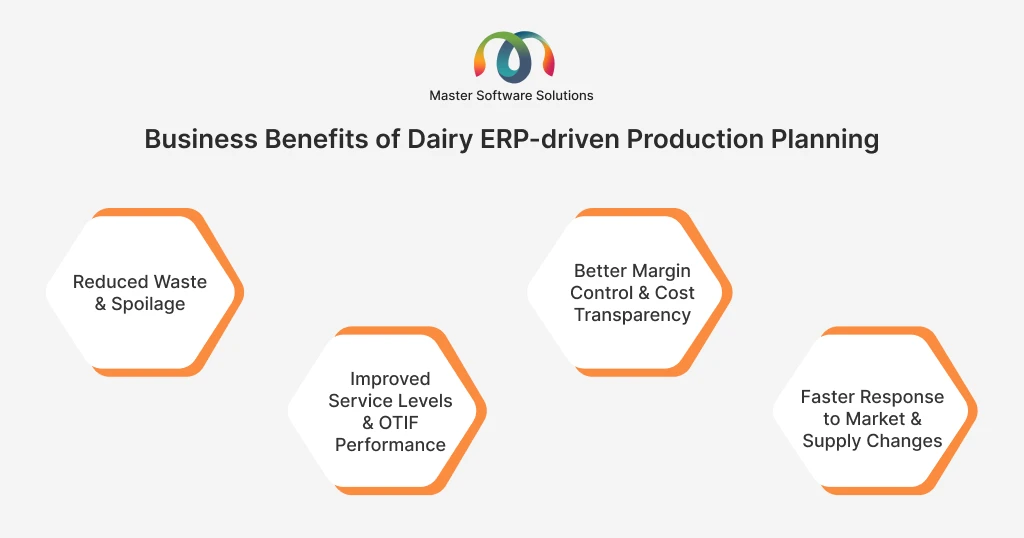
Better margin control and cost transparency
ERP systems provide detailed visibility into production costs, including raw material, labor, utilities, and overheads. Planned costs can be compared to actual results in real time. Yield losses, inefficiencies, and process deviations become visible. This transparency enables better pricing decisions, improved product mix planning, and tighter margin control across dairy operations.
Faster response to market and supply changes
Dairy markets and milk supply conditions change quickly. ERP-driven planning uses real-time data across procurement, production, and inventory. When demand spikes or supply disruptions occur, planners can immediately adjust schedules and priorities. Scenario planning allows teams to evaluate alternatives before execution. This agility reduces risk, improves responsiveness, and helps manufacturers remain competitive.
What to look for in a dairy ERP solution for production planning?
Not all ERP systems are suitable for dairy manufacturing. A dairy-specific ERP must address perishability, quality, compliance, and operational complexity. The following capabilities are critical.
Native dairy functionalities
A dairy ERP should be designed specifically for dairy operations, not adapted from generic manufacturing systems. It must support milk collection, grading, and quality testing at reception. The system should handle fat and SNF variations, yield calculations, and recipe management. Native support for dairy processes reduces customization, improves accuracy, and ensures faster implementation.
Shelf-life and by-product management
Shelf life is a core planning constraint in dairy manufacturing. The ERP must manage expiry dates at the batch and lot levels. It should support FEFO logic and expiry-based production and dispatch planning. The system must also manage dairy by-products such as whey, cream, or skim milk. Proper by-product tracking improves yield utilization, reduces waste, and increases overall profitability.
Multi-plant scalability
Many dairy businesses operate multiple plants, chilling centers, and processing units. A dairy ERP must scale across locations without losing control or visibility. The system should support centralized planning with plant-level execution. It must enable standard processes while allowing local flexibility. This ensures consistent quality, optimized capacity use, and efficient coordination across the network.
MES, SCADA, PLC, QA, and supply chain integration
A dairy ERP should integrate seamlessly with Manufacturing Execution Systems (MES), Supervisory Control and Data Acquisition Systems (SCADA), Programmable Logic Controllers (PLC), quality assurance (QA), and supply chain platforms. MES integration provides real-time production data. SCADA captures real-time quality monitoring, process optimization, and compliance reporting. PLC controls individual machines and production lines. QA integration ensures quality checks, approvals, and holds are embedded in workflows. Supply chain integration aligns procurement, inventory, and distribution. Together, these integrations deliver end-to-end visibility and faster, data-driven decision-making.
Conclusion
Production planning in dairy manufacturing is complex and high-risk. Short shelf life, variable milk supply, strict compliance, and capacity constraints demand precise control. Traditional planning methods are no longer sufficient. Dairy businesses need integrated, real-time systems to stay competitive. The right dairy ERP system improves planning accuracy, reduces waste, strengthens traceability, and increases operational agility. It enables dairy manufacturers to move from reactive decision-making to structured, data-driven control.
Master Software Solutions offers end-to-end ERP implementation services specific to dairy businesses. This includes process assessment, solution design, customization, integrations, deployment, and post-implementation support. The focus is on delivering ERP systems that align with business goals and scale with growth.
MSS built custom dairy ERP solutions on industry-leading platforms such as Odoo and Microsoft Dynamics 365. Leveraging these platforms enables us to deliver dairy ERP solutions that support production planning, inventory control, quality management, traceability, and compliance, fully tailored to dairy-specific requirements.
If you are looking to improve production planning, reduce waste, and strengthen traceability in your dairy operations, contact us for a consultation.