Enterprise Resource Planning (ERP) systems help businesses manage everyday operations like finance, inventory, human resources, and production. While cloud ERP solutions are popular, many organizations still choose on-premise ERP systems because they offer more control over data and system setup. These systems are installed and run on a company’s own servers, making them a reliable option for businesses with specific security, compliance, or customization needs.
This blog explains on-premise ERP systems, their features, and business benefits. This will help you understand whether an on-premise ERP system is the right fit for your organization.
Table of Contents
Understanding ERP systems
Enterprise Resource Planning (ERP) systems are software solutions that help businesses manage and connect their core process in one place. These processes usually include finance, accounting, inventory, sales, purchasing, human resources, and production. By using a single system, businesses can reduce manual work, avoid data duplication, and get a clear view of their operations.
ERP deployments models
The ERP systems can be deployed in different ways, depending on how and where the software is hosted and managed. The main deployment models include:
- On-premise ERP: Installed and run on the company’s own servers and managed by its internal IT team.
- Cloud ERP: Hosted on the vendor’s servers and accessed through the internet. The vendor handles maintenance and updates.
- Hybrid ERP: A mix of on-premise and cloud systems, where some functions run locally and others in the cloud.
Note* Each model offers different levels of control, cost, and flexibility.
On-premise ERP vs. Cloud ERP vs. Hybrid ERP
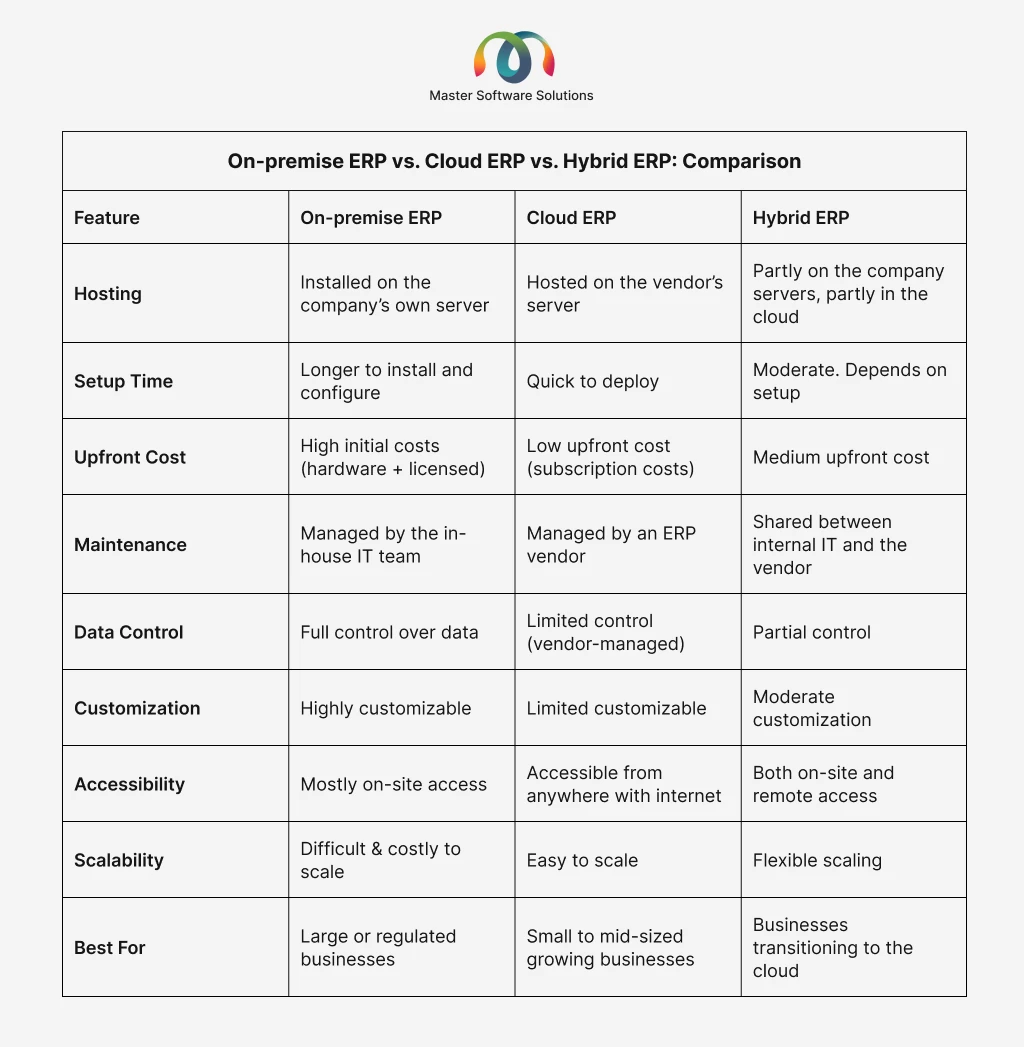
The main difference between these ERP deployment models is where the system is hosted and how it is managed.
- On-premise ERP is installed on a company server, giving businesses complete control over their data, security, and system customization. However, it usually involves higher upfront costs and requires an in-house IT team for maintenance.
- Cloud ERP is hosted on the vendor’s servers and accessed through the internet. It is easier to set up, has lower initial costs, and allows access from anywhere. The downside is limited control over data and fewer customization options.
- Hybrid ERP combines both on-premise and cloud ERP systems. Some business functions run on local servers, while others are managed in the cloud. This model offers a balance between control and flexibility, making it suitable for businesses that want to move to the cloud gradually or keep sensitive data on-site.
On-premise ERP systems: Overview
On-premise ERP systems are software solutions that are installed and run on a company’s own servers and hardware. The business is responsible for managing the system, including setup, security, updates, and maintenance. This model gives organizations full control over their data and how the ERP system is configured.
Many businesses choose on-premises ERP as it enables deep customization and strong data security. It is beneficial for large organizations or industries with strict regulatory requirements. While on-premise ERP systems usually require higher upfront investment and an internal IT team, they offer long-term stability and control for companies with complex operational needs.
Characteristics of on-premise ERP systems
On-premise ERP systems have several characteristics that set them apart from other deployment models.
- Local installation: The ERP software is installed on the company’s own server and hardware, not hosted online.
- Full data control: Businesses have complete ownership and control over their data, security policies, and access management.
- High customization: The system can be tailored to match specific business processes and workflows.
- In-house management: Internal IT teams handle system maintenance, updates, backups, and troubleshooting.
- Higher upfront cost: Initial investment includes software licenses, servers, and infrastructure setup.
- Limited remote access: Access is usually restricted to the company network unless additional configurations are made.
- Strong security compliance: Suitable for industries with strict data protection and regulatory requirements.
These characteristics make on-premise ERP systems a good fit for organizations that need control, customization, and compliance over flexibility and quick deployment.
Industries that leverage on-premise ERP systems
On-premise ERP systems are commonly used in industries where data control, security, and customization are critical. Some of the industries include:
Manufacturing
Manufacturers use on-premise ERP systems to support MRP (Material Resource Planning), production scheduling, bill of materials (BOM) management, and shop-floor control. On-premise deployment allows tight integration with PLC systems, MES software, and legacy production equipment, which often cannot connect reliably to cloud platforms. Custom workflows are commonly built for make-to-order, make-to-stock, or engineer-to-order production models.
Healthcare
Hospitals and healthcare networks use on-premise ERP systems for financial management, procurement, inventory tracking (medical supplies and pharmaceuticals), payroll, and compliance reporting. On-premise ERP supports strict adherence to data protection regulations (such as HIPAA-like frameworks), enabling direct integration with EHR, HIS, and laboratory systems that must remain inside the organization’s secure network.
Banking and financial services
Financial institutions deploy on-premise ERP systems for general ledger, risk reporting, asset management, regulatory reporting, and internal control. On-premise system support segregation of duties, audit trails, and low-latency processing, while allowing institutions to meet regulatory requirements around data residency, encryption standards, and internal governance framework.
Government and public sector
Government entities rely on on-premise ERP systems for budget planning, fund accounting, procurement, payroll, grant management, and compliance auditing. On-premise deployment ensures data sovereignty and supports integration with legacy civil systems, tax platforms, and identity management systems that are often decades old and not cloud-ready.
Retail and wholesale distribution
Retailers and distributors use on-premise ERP systems to manage inventory optimization, warehouse operations, pricing logic, order fulfillment, and supplier management. On-premise ERP allows deep customization for complex pricing structures, volume discounts, regional tax rules, and multi-warehouse coordination, often integrated directly with POS and warehouse automation systems.
Energy and utilities
Energy and utility companies use on-premise ERP systems to manage asset lifecycle, maintenance scheduling, workforce management, procurement, and regulatory reporting. These systems can be integrated with SCADA, GIS, and asset monitoring systems, which ensures on-site processing for performance, reliability, and security.
Defense and aerospace
Defense and aerospace organizations depend on on-premise ERP systems for project-based manufacturing, contract management, compliance tracing, and secure supply chain management. On-premise deployment enables handling classified data, managing controlled access environments, and meeting defense-grade security standards, while also integrating with specialized engineering and compliance systems.
These industries rely on on-premise ERP systems to maintain control over critical data and operations while supporting complex and regulated business environments.
Business benefits of on-premise ERP systems
On-premise ERP systems deliver specific, measurable benefits for organizations with complex operations, regulatory pressure, or legacy infrastructure. Here are the advantages of implementing an on-premise ERP system:
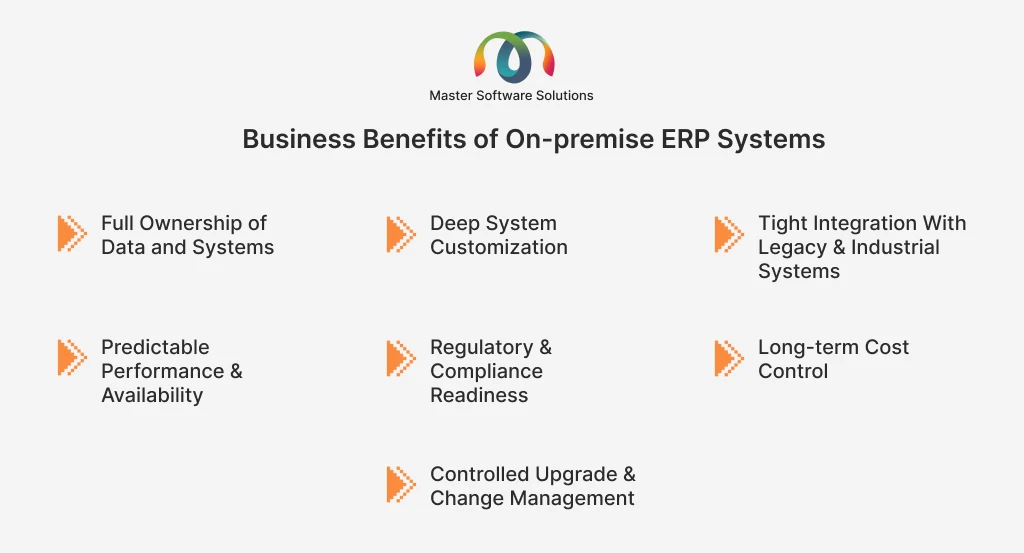
Full ownership of data and systems
All data, applications, and databases remain within the organization’s infrastructure. This eliminates dependency on third-party hosting providers and supports strict data residency, governance, and internal security policies.
Deep system customization
On-premises ERP allows direct modifications of business logic, workflows, reports, and integrations. This is crucial for businesses with non-standard procedures that cloud-based configuration limitations find difficult to support.
Tight integration with legacy and industrial systems
On-premise ERP systems integrate more reliably with existing platforms such as MES, SCADA, PLCs, POS systems, and custom in-house applications that require low latency and on-site connectivity.
Predictable performance and availability
System performance is not dependent on internet bandwidth or external cloud outages. Organizations can control server capacity, failover strategies, and system uptime based on operational priorities.
Regulatory and compliance readiness
On-premise ERP supports detailed audit trails, role-based access control, and internal compliance frameworks required in regulated industries such as finance, healthcare, defense, and government.
Long-term cost control
Although the initial investment is higher, organizations avoid recurring subscription fees and forced upgrade cycles. Over long system lifecycles, this can result in lower total cost of ownership.
Controlled upgrade and change management
Businesses decide when and how to apply upgrades, patches, or system changes, reducing operational risk and avoiding disruptions to mission-critical processes.
Where can on-premise ERP systems be a great success?
On-premise ERP systems are most successful in environments where operational complexity, regulatory control, and system integration requirements outweigh the need for rapid deployment or cloud flexibility.
Highly regulated industries
On-premise ERP excels in sectors such as banking, healthcare, government, defense, and utilities, where strict data residency, auditability, and compliance controls are mandatory. Keeping systems in-house simplifies regulatory reviews and internal governance.
Organizations with complex or unique processes
Businesses with heavily customized workflows, such as engineer-to-order manufacturing, project-based operations, or multi-entity structures, benefit from the deep customization capabilities of on-premise ERP.
Enterprises with significant legacy infrastructure
Companies that rely on older but mission-critical systems (MES, SCADA, POS, mainframes, or proprietary applications) achieve better reliability and performance when ERP runs within the same on-site environment.
Larger-scale, high-transaction operations
On-premise ERP performs well in environments with high transaction volumes and low tolerance for latency, such as manufacturing plants, logistics hubs, and financial operations centers.
Organizations with strong internal IT capabilities
Businesses with experienced IT teams and established infrastructure can effectively manage on-premise ERP, optimizing performance, security, and long-term system evolution.
Long-term ERP users seeking stability
Organizations that prioritize system stability over frequent feature changes find success with on-premise ERP, as upgrades and enhancements can be planned around business cycles rather than vendor schedules.
Confused about which is best for your business?
It can be overwhelming to choose between on-premise ERP, cloud ERP, and hybrid ERP. However, choosing the right ERP deployment model depends on your business priorities, operational complexity, and long-term strategy.
When to choose on-premise ERP?
On-premise ERP is the right choice if your business needs maximum control and customization. Choose on-premise ERP when:
- You operate in a highly regulated industry with strict data residency or compliance requirements.
- Your business processes are highly customized and cannot fit standard cloud configurations.
- You rely on legacy systems or industrial software that requires on-site integration.
- You have a strong internal IT team to manage infrastructure, security, and upgrades.
- System performance and availability cannot depend on internet connectivity.
When to choose cloud ERP?
Cloud ERP is best for businesses that value speed, flexibility, and lower upfront costs. Choose cloud ERP when:
- You want quick deployment with minimal infrastructure investment.
- Your processes are standardized and align with best-practice workflows.
- You need remote access for distributed teams or multiple locations.
- You prefer predictable subscription pricing instead of capital expenditure.
- Your IT team is small, or you want the vendor to handle maintenance and upgrades.
When to choose a hybrid ERP?
Hybrid ERP works well for organizations that need both control and flexibility. Choose a hybrid ERP when:
- You want to use cloud modules for less important tasks while keeping critical systems or sensitive data on-site.
- Your business is transitioning to the cloud gradually rather than all at once.
- Different departments have different operational or compliance needs.
- You want to modernize parts of your ERP without replacing the entire system.
Conclusion
Choosing the right ERP deployment model (on-premise, cloud, or hybrid) depends on your business structure, regulatory needs, and long-term growth strategy. For many organizations, especially those with complex operations and strict control requirements, on-premise ERP systems continue to deliver reliability, deep customization, and operational stability.
Master Software Solutions offers end-to-end ERP consulting services, including requirement analysis, configuration, customization, integration, deployment, and ongoing support. We leverage ERP platforms such as Odoo and Microsoft Dynamics 365 to build scalable and flexible ERP solutions that align with both operational needs and future expansion plans.
Get in touch to explore how a customized ERP solution can improve efficiency, visibility, and long-term business performance.