Subscription-based dairy businesses are becoming common, including home milk delivery, institutional supply contracts, and direct-to-consumer models. These subscription models foster steady revenue and loyal customers. However, this also means new planning challenges.
Many dairy businesses still use manual or basic software for production planning. These tools are not sufficient. They cannot handle frequent demand changes, as they lack real-time visibility across sales, production, and delivery.
Dairy ERP software connects subscription data with demand forecasting, production planning, inventory, and distribution, making demand more predictable and operations more profitable.
Table of Contents
Understanding subscription-based demand in the dairy industry
Subscription-based dairy demand means customers receive dairy products on a fixed schedule. Deliveries can be daily, alternate days, or weekly. Routes are usually fixed; however, the quantities can often change.
Types of dairy subscriptions
- Household subscriptions: These are small-volume subscriptions. Orders are frequent, often daily. Customers may change quantity, pause delivery, or cancel at any time.
- Commercial subscriptions: These include hotels, cafes, offices, and institutions. Volumes are higher than households. Although demand is more consistent, usage and season can affect it.
Key demand characteristics in dairy subscriptions
- High order frequency: Orders repeat daily or weekly. Planning must be done often and quickly.
- Short shelf life: Milk and dairy products spoil quickly. Unsold stock leads to losses.
- Demand variations: Demand changes with seasons, weather, festivals, and customer habits.
Core challenges in managing dairy subscriptions
Managing dairy subscriptions is complex. Demand changes often, and the products spoil quickly. This means deliveries must happen on time. Small mistakes can cause losses or unhappy customers. Here are the challenges dairy subscriptions face.
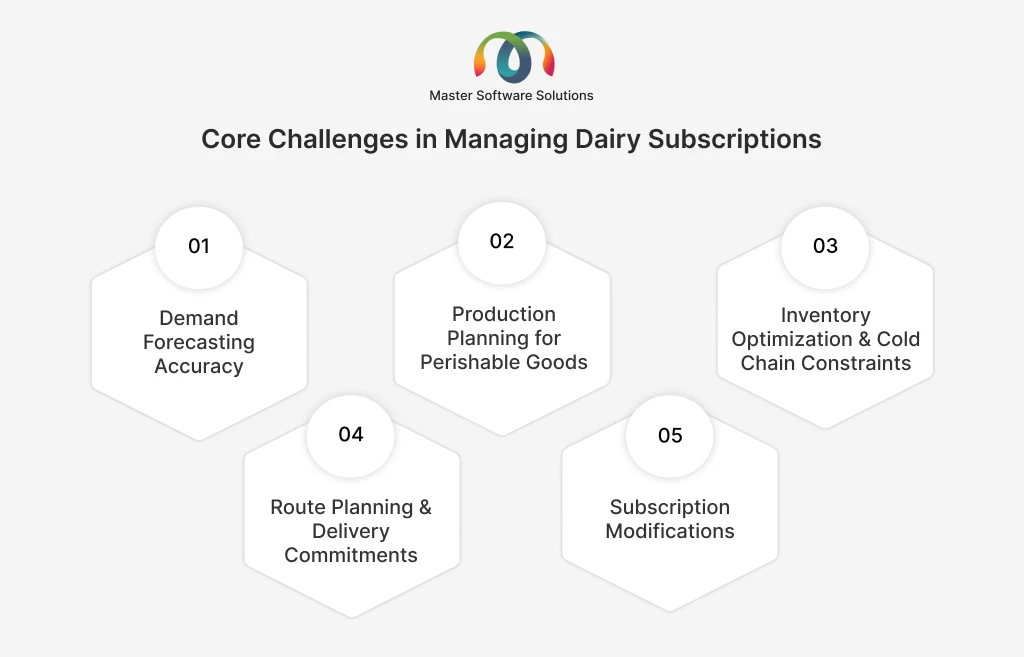
Demand forecasting accuracy
Demand is not fixed. Customers often change quantity. Some pause or cancel with notice. Weather and seasons also affect demand. Without accurate forecasts, dairies guess production needs, leading to waste or shortages.
Production planning for perishable goods
Milk and dairy products have a short shelf life. They must be produced fresh every day. If production is high, the product spoils. If production is low, orders are missed. Planning must match daily demand exactly.
Inventory optimization and cold chain storage constraints
Cold chain spaces are limited and costly to run. Excess stock occupies storage space, and too little stock affects delivery. Dairies must balance freshness, quantity, and storage capacity.
Route planning and delivery commitments
Delivery routes are usually fixed. Customers expect delivery on time. Demand differs by route and location. Traffic and distance add risks. Poor route planning causes delays and higher fuel costs.
Subscription modifications (pause, change quantity, cancel)
Customers may pause deliveries. They may increase or reduce the quantity. Some may cancel fully. These changes happen often and with short notice. If systems are manual, updates are missed. This affects planning and delivery.
Role of dairy ERP software in subscription demand management
Dairy ERP software helps dairies better manage daily subscription demand. It brings all data into one system. This helps teams plan, act, and respond faster. It reduces waste and improves service. Ways dairy ERP software helps dairy businesses manage subscription demand.
Centralized subscription data
In many dairies, subscription data is stored across multiple systems. Some data sits in billing tools, some with sales teams, and some is tracked on paper or sheets, leading to errors. A dairy ERP system stores all subscription data in one system. Each customer has a complete and accurate record. The delivery days, product types, and quantities are clearly defined. Pricing and contract terms are also linked. When a customer makes a change, the system updates instantly. All teams see the latest information. This prevents incorrect production and delivery issues.
Consolidated real-time demand
Subscription demand comes from many customers with different needs. Some require a daily supply, while others need deliveries on fixed days. The dairy ERP system collects demand from all active subscriptions and combines this data to show the total daily demand. Demand is also grouped by delivery route and location. Planners can clearly see how much to produce each day. They can plan loads based on route-level demand, improving delivery accuracy and resource use.
Automated forecast-to-production
Manual forecasting is time-consuming and unreliable. It often depends on estimates, and frequent subscription changes make it harder to forecast. A dairy ERP uses historical data to create forecasts. It identifies daily, weekly, and seasonal patterns and automatically updates forecasts when subscriptions change. Based on the demand forecast, the system generates a production plan that shows required quantities and timelines. This reduces manual work and improves planning accuracy.
Integrated sales, production, inventory, and logistics
Many dairy businesses that use multiple systems experience coordination gaps. The sales team operates independently of production, delaying updates from the inventory and delivery teams. A dairy ERP system connects all operational functions, ensuring that sales orders flow directly into production planning. The inventory levels are automatically updated in real time from production. Inventory data supports accurate dispatch planning. The integrated logistics module receives clear delivery schedules. All teams work with the same data, improving coordination and operational efficiency.
Key dairy ERP features that enable subscription control
The dairy ERP software offers features that help businesses manage subscription-based demand effectively. These features support daily planning, reduce manual work, and improve accuracy. They help dairies handle frequent order changes, control production, manage inventory, and ensure on-time delivery. These capabilities provide better visibility and stronger control over subscription operations. Here are the key dairy ERP features that enable subscription control.
Subscription and contract management
Subscription and contract management help dairies handle recurring customer orders with ease. The ERP allows businesses to set up recurring order templates for daily or periodic deliveries. Each customer can have specific pricing and fixed or flexible volume commitments. When customers pause, change quantity, or cancel a subscription, the system updates everything automatically. This ensures that production and delivery plans always reflect the latest customer needs.
Demand forecasting and analytics
Demand forecasting and analytics help dairies accurately predict future subscription demand. The ERP analyzes past consumption data to understand customer buying patterns. It uses this data to create demand forecasts. Advanced systems can also adjust forecasts based on seasons, weather, and festivals. This helps dairies prepare for demand changes in advance and avoid sudden shortages or excess stock.
Production planning and procurement
Production planning ensures that the right quantity is produced every day. The ERP creates daily production schedules based on subscription demand. It also supports fat- and SNF-based milk allocation to meet quality needs for dairy products. At the same time, the system aligns milk procurement from farmers or suppliers with production plans. This helps maintain product quality while controlling procurement costs.
Inventory and shelf life tracking
Inventory and shelf-life tracking help dairies better manage perishable products. The ERP tracks inventory at the batch level, making it easy to trace each product. It monitors expiry dates and supports stock rotation based on shelf life. This ensures older stock is used first. The system also tracks wastage and spoilage. These insights help reduce losses and improve inventory control.
Distribution and route optimization
Distribution and route optimization help ensure timely deliveries. The ERP consolidates demand by delivery route and location. This helps plan accurate delivery loads for each route. The system also optimizes delivery schedules to reduce travel time and fuel use. If a delivery is missed or delayed, the ERP system records the issue and flags exceptions, enabling businesses to improve service quality and customer satisfaction.
Subscription demand in a dairy ERP: Workflow
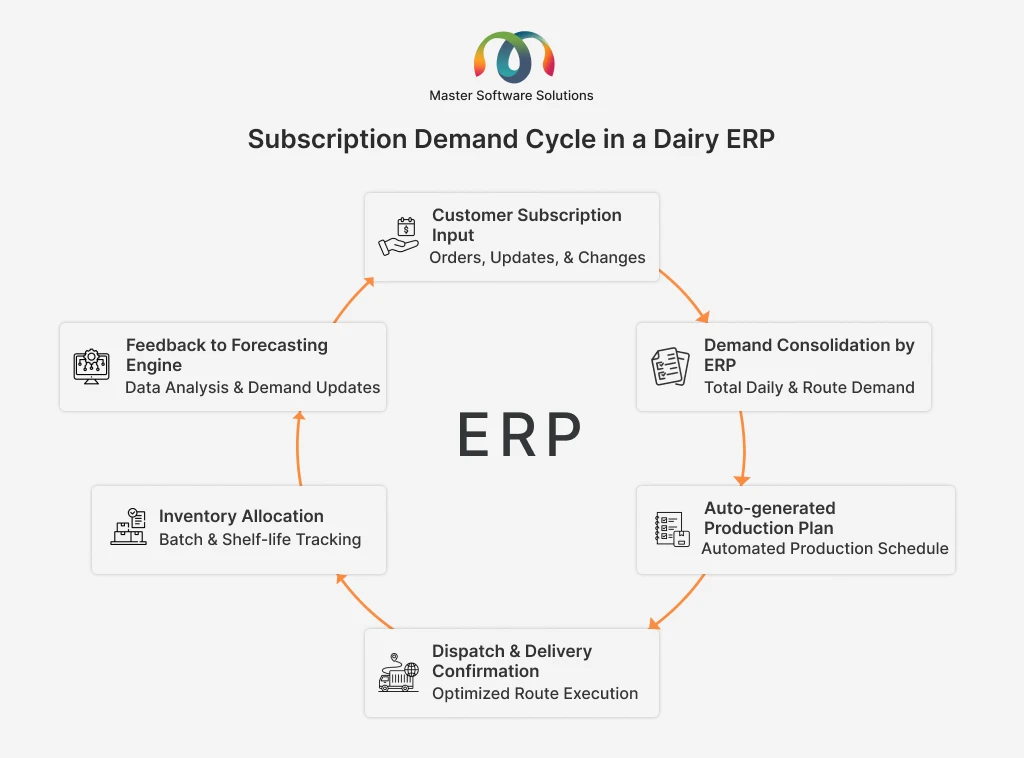
This section explains how a dairy ERP system manages subscription-based demand step-by-step. It shows how customer orders flow through the system, from subscription input to delivery. The workflow shows how the ERP system links subscriptions, production, inventory, and logistics to improve efficiency and reduce errors. Here is a step-by-step workflow of subscription demand management.
1. Customer subscription input
The process begins when the customer creates or updates a subscription. The ERP records the customer’s delivery schedule, product type, and quantity. Changes such as pauses, quantity changes, or cancellations are updated instantly. This ensures that the system has the latest customer information, which forms the basis for all planning and production activities.
2. Demand consolidation by ERP
Once all subscriptions are recorded, the ERP system consolidates demand across customers and delivery routes. It calculates total daily and route-wise demand for each product. This helps planners understand exactly how much milk or other dairy products are needed on a given day. Consolidation ensures that no orders are missed and resources are used efficiently.
3. Auto-generated production plan
Based on the consolidated demand, the system generates a production plan. The plan specifies the quantity of each product to produce and the production schedule. It also considers available raw materials and milk quality requirements. This automation reduces manual planning errors and ensures production matches actual customer demand.
4. Inventory allocation
After the production plan is set, the system allocates inventory for each product batch. It tracks available stock, assigns products to specific orders, and manages expiry dates. Batch-level traceability ensures that older stock is used first and that products are ready for delivery on time. This step reduces wastage and ensures freshness.
5. Dispatch and delivery confirmation
The ERP generates delivery schedules based on route optimization and order priorities. Drivers receive clear instructions, and the system tracks deliveries in real time. Any missed deliveries or exceptions are recorded. Once the product is delivered, the ERP updates the order status, keeping all teams informed.
6. Feedback loop into forecasting engine
After deliveries, the ERP uses actual order and consumption data to improve future forecasts. Customer behaviour, seasonal trends, and route performance feed into the forecasting engine. This feedback loop makes future demand predictions more accurate, helping production, procurement, and logistics planning.
Benefits of using dairy ERP for subscription models
Implementing ERP software for the dairy industry improves operational efficiency, reduces waste, enhances service quality, and strengthens customer relationships. These benefits can help dairy businesses save costs and grow sustainably. The benefits of implementing dairy ERP for subscription models.
Reduced wastage and returns
Dairy ERP helps match production with actual demand. The system tracks daily subscription volumes, consolidates orders, and manages inventory efficiently. This prevents overproduction and reduces the number of expired or unsold products. As a result, wastage and product returns are minimized, saving costs and better resource utilization.
Higher service-level adherence (OTIF)
OTIF, or On-Time-In-Full delivery, essential for subscription-based dairy businesses, optimizes delivery routes, monitors order fulfillment, and provides real-time updates to teams. This ensures that customers receive their orders on time and in the right quantity, improving reliability and trust.
Improved capacity utilization
The ERP system for dairy businesses helps plan production to actual demand, ensuring that processing units, machinery, and storage are used efficiently. Aligning production schedules with customer requirements prevents resource underutilization or overloading, improving overall operational efficiency.
Lower operational overhead
Automating subscription tracking, production planning, inventory management, and logistics reduces manual work. This decreases administrative effort, prevents errors, and lowers labor costs. Teams can focus on more strategic tasks rather than repetitive manual updates.
Better customer retention and lifetime value
The ERP system improves customer experience by ensuring timely deliveries, accurate orders, and easy subscription management. Customers can pause, change, or cancel orders smoothly, and the system keeps all updates accurate. Better service and reliability increase customer satisfaction, retention, and long-term business value.
Implementation considerations for dairy businesses
There are various key factors dairy businesses should consider before implementing an ERP system. These considerations address common concerns related to system setup, data accuracy, integrations, and team adoption. Understanding them ensures a smooth ERP rollout and long-term success. Here are the implementation considerations for dairy businesses.
ERP customization vs. configuration
Dairy businesses often wonder whether the ERP should be customized or configured. Configuration means using standard ERP features with minor settings changes. Customization means building new features to match specific needs. Configuration is faster, lower risk, and easier to maintain. Customizations should be limited to critical business needs to avoid higher costs and delays.
Data migration and master data accuracy
ERP systems depend on clean and accurate data. During implementation, existing data, such as customers, products, routes, and pricing, must be migrated into the ERP. If this data is incorrect or incomplete, the ERP will not work properly. Careful data review and validation are essential to ensure smooth operations after go-live.
Integration with IoT, milk analyzers, and billing systems
Modern dairy operations use many connected systems. These include milk analyzers, weighing machines, IoT sensors, and billing software. The ERP must integrate with these systems to automatically share data. Proper integration reduces manual entry, improves accuracy, and provides real-time visibility across operations.
Change management for production & delivery teams
ERP implementation changes how teams work every day. Production and delivery staff must follow new processes and use new tools. Without proper training and support, teams may resist the system. Clear communication, hands-on training, and gradual adoption help teams adjust and effectively use the ERP system.
Bottom-line
Managing subscription-based dairy demand requires accuracy, speed, and strong coordination across operations. Daily demand changes, short product life, and strict delivery schedules make accuracy essential. A well-implemented dairy ERP system can handle these challenges, improving demand visibility, reducing waste, streamlining production, and ensuring reliable deliveries.
Master Software Solutions offers end-to-end dairy ERP implementation services, from requirement analysis and system design to deployment, integration, and ongoing support. We focus on building custom solutions that fit real dairy operations, unlike generic ERP setups.
We offer tailored dairy ERP solutions built on proven platforms, such as Odoo and Microsoft Dynamics 365. These platforms are configured and extended to meet dairy-specific needs, including subscription management, production planning, inventory control, quality tracking, and distribution management. These solutions ensure scalability, flexibility, and long-term value for growing dairy businesses. If you are looking to improve control over subscription demand and optimize your dairy operations, book a consultation.