The dairy supply chain is highly complex in terms of operations, managing finances, and traceability. Finances are the most crucial aspect of the business, as they define the growth and longevity.
However, unexpected fluctuations in milk procurement prices, thin margins, high working-capital pressure, and complexity due to perishability, yield losses, and by-products make it challenging for dairy businesses to manage finances and control margins.
This is where dairy ERP software comes in. It can consolidate all your financial transactions, from farmer payments and transportation costs to sales expenditure and customer payments, into a single platform.
Table of Contents
Financial visibility in the dairy businesses
Financial visibility in dairy businesses refers to real-time tracking, analysis, and management of the cash flow, from milk collection to finished goods. It includes costs, transactions, and payments related to the movement of milk and dairy products across the entire supply chain. This means understanding where every dollar is earned or lost across the milk lifecycle. Financial visibility may include:
Real-time cost tracking
A dairy ERP captures costs at three major stages, including
- Milk procurement costs (fat/SNF-based pricing, transportation, chilling)
- Processing costs (labor, utilities, cultures, and packaging)
- Storage and logistics costs (cold chain, handling, distribution)
Instead of waiting for the month-end report, you can view the real-time cost per liter or per batch, enabling faster decisions when procurement prices rise or processing costs spike.
Batch-wise and SKU-wise profitability
In the dairy business, a single batch of milk can be split into multiple products, such as liquid milk, curd, butter, cheese, ghee, whey, etc. In this case, financial visibility refers to:
- Knowing profitability per production batch
- Tracking margins per SKU, pack size, and product category
- And, understanding how much each product contributes to the overall profit
A dairy ERP allocates costs accurately across co-products and by-products to identify:
- High margins vs. low-margin SKUs
- Products that look profitable at a high level but lose money in reality
Visibility in yield variance, wastage, and shrinkage
In the dairy industry, even small yield losses can wipe out significant margins. With respect to yield variance, wastage, and shrinkage, the ERP system provides financial visibility, including:
- Planned vs. actual yield comparison (fat recovery and SNF recovery)
- Loss tracking due to spoilage, evaporation, expiry, or quality rejection
- Financial impact of shrinkage in production, storage, or distribution
A dairy ERP transforms technical losses into financial gains, helping management with answers, such as
- How much margin was lost due to yield variance?
- Which plant, line, or shift is causing higher losses?
- Whether losses are operational, quality-related, or systematic.
Integration of procurement, production, inventory, & sales data
Businesses using traditional systems struggle due to fragmented financial data across systems. True financial visibility only exists when:
- Milk procurement data feeds directly into costing
- Production data updates the inventory value in real-time
- Sales pricing and discounts are linked to the actual product cost
- Finance sees a single version of truth across departments
The dairy ERP system integrates all functions so that
- Inventory valuation is the real-time reflection of production costs
- Sales margins are calculated instantly
- Management can trace margin issues back to procurement, yield, or pricing decisions
Why are traditional accounting systems not sufficient for dairy operations?
Traditional accounting systems are independent platforms that enable businesses to manage overall financial transactions, get key insights into their financial health, manage cash flow, ensure compliance, and support decision-making. The drawback of these systems is that you have to manually enter data from multiple systems, including procurement, production, and sales.
Also, these systems are designed to record financial outcomes. They cannot manage process-driven, yield-sensitive businesses like dairy. This increased the chances of errors, delays, and reconciliations, and doesn’t provide real-time updates. Here is why traditional accounting is not sufficient for dairy operations:
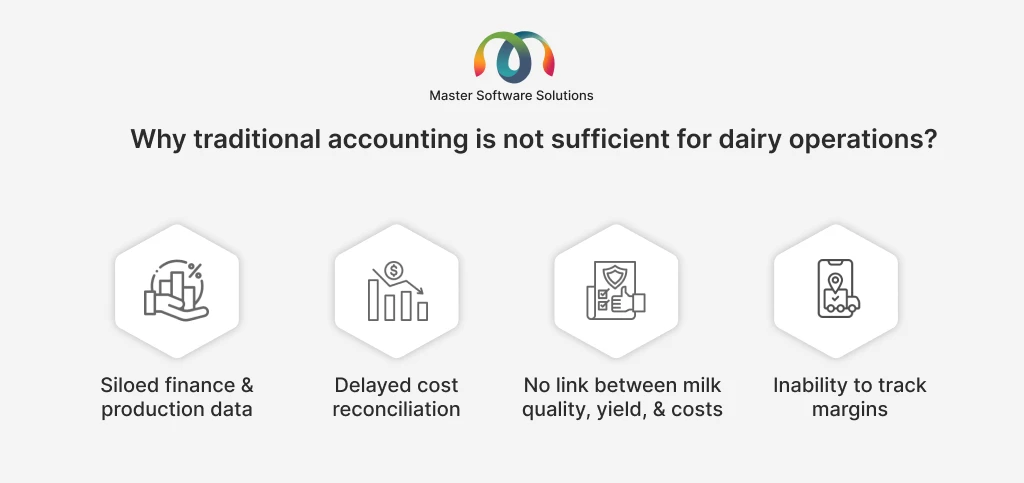
Siloed finance & production data
In most dairy businesses, the finance team uses accounting software, the production team works in MES, plant logs, or spreadsheets, and the procurement team tracks milk collection on a separate system.
Traditional accounting systems can capture only summarized costs, not the detailed ones. It doesn’t provide real-time linkage to milk collection, processing, or yield data, making it difficult to trace costs back to specific batches, lines, or shifts.
Here, you may know the total processing cost, but not:
- Which product consumed more resources
- Which plant or batch eroded the margins
- Whether losses were due to yield, downtime, or inefficiency
Delayed cost reconciliation
Your traditional accounting software can only calculate inventory valuation, Cost of Goods Sold (COGS), and gross margins only after month-end closing. This delay can be risky as milk prices fluctuate daily, yield losses occur immediately, and perishable products such as milk lose value quickly.
By the time finance detects margin drops, cost overruns, and inventory write-offs, the damage is already done. Management is left with a retrospective reaction rather than proactive improvement of procurement or pricing decisions in real time.
No link between milk quality, yield, & costs
Milk consistency varies, and its value depends on fat%, SNF%, and quality parameters, such as acidity, adulteration, and microbial count. Traditional accounting systems generally treat milk as a single cost line item, ignoring quality-based pricing and yield. It can not correlate poor-quality milk with lower product yield, higher processing loss, and increased cost per unit.
These can result in businesses overpaying for low-quality milk, misinterpreting yield loss as operational inefficiency, and failing to hold suppliers or routes accountable.
Inability to track margins
Dairy is a co-product industry, which means one milk batch can become multiple finished goods. Each product has different yield ratios, processing costs, shelf life, and market prices. Conventional accounting systems can only allocate costs using averages or percentages and cannot accurately split costs across co-products. They provide only product-category-level margins.
In this, you cannot identify loss-making SKUs, optimize product mix, or understand the true profitability of value-added products. This also makes it difficult to decide whether converting milk into a product is financially justified.
How does dairy ERP provide complete financial visibility?
The ERP software integrates finance and accounting into daily dairy operations, from milk collection to final sales. Each step of the dairy supply chain carries financial data, which the system provides in real time. This enables businesses to see costs, margins, and risks as they occur. Here are the features of the dairy ERP system that offer complete financial visibility.
Milk collection & farmer payments
This step accounts for 65-75% of the total product cost. The ERP system automatically calculates milk value based on fat and SNF percentages, quality parameters (acidity, adulteration, & microbial count), and predefined pricing slabs and incentives or penalties. This ensures fair and accurate payments to the farmers. This directly links milk quality with procurement costs, eliminating manual errors or disputes.
As you receive milk, the ERP system updates the cost per liter, route-wise & collection-center-wise procurement costs, and daily and cumulative milk purchase value. This enables you and your team to see cost trends and respond to price fluctuations quickly.
The system provides accurate farmer payments and enables subsidy tracking. You can track farmer-wise milk quantity and quality, their incentives, subsidies, and deductions, and payment cycles and outstanding liabilities. This will provide you with full financial traceability from milk collection to farmer payout, improving trust and audit readiness.
Production costing & yield analysis
Production defines profitability based on cost efficiency and yield discipline. The system can link physical milk processing with the financial outcomes. You can manage batch-wise costing across multiple products. Your single batch of milk can produce liquid milk, curd, cheese, butter, and SMP & by-products.
The ERP system can accurately allocate raw milk, labor, energy, and packaging costs; split shared costs across co-products; and calculate true cost per product and per batch. This eliminates average-based costing and exposes real product expense.
The system can also compare standard yield (expected fat/SNF recovery) and the actual yield achieved during production, highlighting even small deviations. These deviations may include technical inefficiencies, quality-driven losses, and process or equipment issues. These may be due to spillage, reprocessing, and downgrading product quality, ultimately leading to financial losses.
The system defines these losses as financial and tracks the monetary contribution of your by-products, such as whey or cream, giving a complete profitability picture.
Inventory & cold chain cost control
Inventory in dairy is highly perishable and highly dependent on the cold chain, increasing the risks. The system provides continuous valuation and risk visibility. The ERP system enables you to implement inventory management strategies such as FIFO (First-In-First-Out) for cost accuracy and FEFO (First-Expiry-First-Out) to reduce spoilage. This ensures that inventory is valued correctly, dispatched optimally, and aligned with shelf life limitations.
The ERP system can flag near-expiry stock, slow-moving SKUs, and potential write-offs, enabling proactive adjustments to pricing and pushing promotions. This helps reduce waste-related losses. The dairy ERP system allocates cold storage costs, transportation and fuel expenses, and route-wise and product-wise logistics costs, revealing the true cost of distribution. This also enables you to identify margin leakage in the dairy supply chain.
Sales, pricing, & margin tracking
Your sales decisions directly affect margin realization. The dairy ERP system connects pricing and sales execution with actual product costs. The system allows you to analyze margins based on SKU and customer. It can auto-calculate margin by product, pack size, channel (retail, institutional, and distributor), and customer or route. This enables you to identify profitable SKUs, loss-making customers or channels, and pricing mismatches.
The system allows tracking the trade schemes, discounts, and promotions against the actual cost and incremental volume. You and your team can see whether promotions are increasing net contribution or merely boosting volume while eroding margin.
Instead of waiting for the month-end report, the ERP system provides real-time visibility into contribution margins, enabling you to adjust pricing. This ensures that your sales strategies are aligned with the cost realities.
Improving margin control with the ERP system for the dairy businesses
Financial visibility is only beneficial if you can take timely corrective action. A dairy ERP can convert operational and financial data into informed, decision-ready insights, enabling you to act on time. Here are ways you can improve margin control with financial visibility:
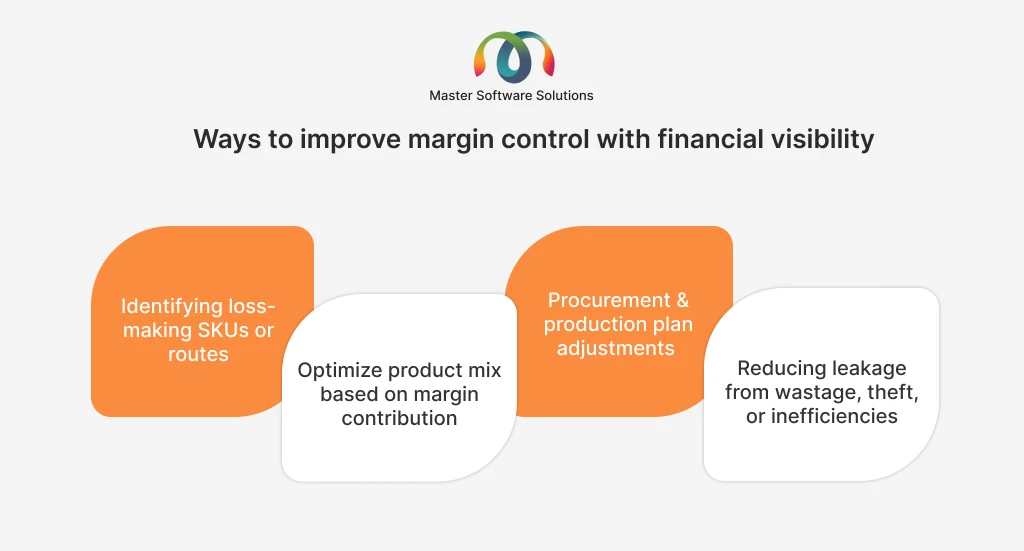
Identifying loss-making SKUs or routes
The dairy ERP combines actual procurement, production, packaging, cold chain, logistics, sales price, discounts, and return costs to calculate SKU-, pack-, and route-wise margins. This can unveil SKUs that appear profitable at the gross level but lose money after distribution. You can identify small pack sizes with high packaging and handling costs, and sales routes with high fuel, low drop size, or high returns.
This enables you to discontinue or reprice loss-making SKUs, optimize pack sizes or channels, and redesign routes or shift customers to more efficient delivery models. Without an efficient ERP system, these losses remain hidden inside the average.
Optimize product mix based on margin contribution
In the dairy industry, volume does not generally equal profitability. A dairy ERP enables you to see the contribution margin per liter of milk for each product. For instance, liquid milk may have high volume but low margins, or value-added products may deliver higher contribution per liter, or by-products may offset losses in primary products.
These insights enable management to compare products on a margin-per-liter basis, identify the most efficient use of available milk, and align production plans with market demand and profitability. You can now shift milk allocation towards higher-margin products, reducing overproduction of low-margin SKUs and making informed decisions when milk is surplus or short.
Procurement & production plan adjustments
In the dairy industry, milk prices, energy costs, and packaging material costs can change rapidly. A dairy ERP reflects these changes in real time in product cost and margins. When costs increase, the system shows the immediate impact on cost per liter, which products are most affected, and the margin loss at the SKU and channel levels.
This enables your teams to renegotiate procurement pricing or quality thresholds, modify fat/SNF utilization strategy, adjust production volumes, or temporarily pause marginal SKUs, and proactively revise pricing or promotions. These prevent continued production at negative or near-zero margins.
Reducing leakage from wastage, theft, or inefficiencies
Margin leakage often occurs in small, repeated losses that are hard to detect without integrated data. A dairy ERP alerts to yield variance beyond acceptable thresholds, abnormal inventory shrinkage, excessive returns, or expirations by route or distributor, and sales realization. The ERP system assigns financial value to these variances, making losses visible and accountable.
This enables you to investigate specific plants, shifts, or routes and tighten process controls and SOP compliance, improving cold-chain discipline and strengthening audits and accountability mechanisms.
Key financial performance indicators
The ERP system uses data from multiple departments, including procurement, production, inventory, sales, etc., to provide consolidated financial reports. This enables you to use these insightful reports to monitor your business’s financial health in real time. Here are the key financial performance indicators.
Cost per Liter Dashboard
This dashboard shows the cost of milk collected per liter (based on fat/SNF percentage), processed per liter (labor, utilities, cultures, and packaging costs), distribution, and cold chain. It also provides total end-to-end per liter by plant, route, or product category.
This enables you to detect cost inflation immediately, compare plants or routes on cost efficiency, decide when pricing revisions or cost controls are required, and evaluate make-vs-buy or outsource logistics decisions.
Product-wise Gross & Net Margin Dashboard
The dashboard provides insights on gross margin per SKU, which is the selling price minus direct cost. You can also track your net margin after logistics, trade schemes, and overhead allocation. The system allows you to view the margin by product, pack size, channel (retail, institutional, or distributor), and customer or route.
Tracking gross and net margins product-wise is crucial, as high-volume products are not always profitable. Some SKUs subsidize others and silently destroy the value due to packaging, distribution, or returns. However, insights from this dashboard enable you to identify loss-making SKUs or customers and reprice, redesign, or even discontinue unviable products. You can optimize channel mix based on contribution and align sales incentives with profitable growth.
Yield Variance & Loss Dashboard
The dashboard compares standard vs. actual yield and helps you identify processing losses by plant, line, shift, or product. It also provides the financial value of lost yield and of rework. Although yield losses may appear small per batch, they become significant when a large volume of batches is involved.
You can pinpoint operational inefficiencies, correlate milk quantity with yield performance, justify maintenance, training, or process improvements, and hold plants or teams accountable using data and not assumptions.
Inventory aging & expiry risk dashboard
This dashboard in an ERP system provides information on inventory by age bucket (fresh, near-expiry, and expired), SKU-wise and location-wise aging, expected write-offs due to expiry, and slow-moving and blocked inventory.
Dairy products have a limited shelf life, require cold storage, and can lose value rapidly if not sold on time. The system triggers price-offs or promotions for near-expiry stock, improves FEFO compliance, reduces overproduction of slow-moving SKUs, and optimizes inventory levels and plant dispatch planning.
Working capital and cash flow cycle dashboard
The dashboard shows Days Inventory Outstanding (DIO), Days Receivable Outstanding (DRO), Days Payable Outstanding (DPO), Cash Conversion Cycle (CCC), and daily cash inflows and outflows. The dairy business faces a daily cash outflow for milk procurement and a delayed cash inflow from distributors and institutions, creating constant working-capital pressure.
Understanding these indicators can help you improve collection discipline and credit terms. It enables you to balance farmer payment cycles with receivables. This reduces inventory holding without risking service levels and allows you to plan short-term financing and liquidity more accurately.
Advantages of implementing dairy ERP software
A dairy ERP software produces measurable, repeatable financial outcomes. It controls variables unique to dairy, such as milk cost, yield, perishability, and working capital, which impact business profitability. Here are the benefits of implementing dairy ERP software for financial visibility and margin control.
Improved margin predictability
The system provides real-time visibility into costs and margins at the batch, SKU, and product levels. Instead of discovering margin depletion at month-end, businesses can track it as it happens. This leads to more stable and predictable margins, better forecasting, and greater confidence in pricing and production decisions.
Faster month-end close
With continuous inventory valuation and automated cost allocation, much of the financial reconciliation is already done before the month ends. As a result, finance teams can close books faster, reduce manual adjustments, and spend more time analyzing performance rather than compiling numbers.
Reduced inventory write-offs
Perishability is one of the biggest profit risks in dairy. A dairy ERP enables real-time inventory aging, expiry alerts, and FEFO (First-Expiry-First-Out) controls. This helps businesses proactively manage near-expiry stock, reduce wastage, and directly protect EBITDA.
Better pricing and procurement decisions
Linking milk quality, yield, and processing costs to product-level margins ensures that pricing and procurement decisions are data-driven. Businesses can avoid selling below true cost, negotiate with suppliers, and design promotions that increase contribution.
Higher EBITDA through loss control
Many dairy losses, including yield variance, spillage, rework, and expirations, are small individually but significant collectively. Dairy ERP quantifies these losses in financial terms and makes them visible by plant, line, or route. This enables timely corrective action and delivers sustainable EBITDA (Earnings Before Interest, Taxes, Depreciation, and Amortization) improvement without relying on volume growth.
Conclusion
Profitability in the dairy business depends on financial stability, margin control, and the ability to act on data in real-time. The dairy ERP system plays a critical role in transforming disconnected operations into financial discipline, from milk procurement and yield management to inventory control and pricing decisions.
Enabling real-time cost tracking, SKU-level margin analysis, proactive loss control, and faster financial close empowers dairy owners to move from reactive accounting to proactive margin management. This ensures measurable improvements in EBITDA, cash flow, and operational efficiency.
Master Software Solutions (MSS) partners with dairy businesses to design and implement tailored dairy ERP solutions to cater to their specific operational and financial needs. With deep domain understanding of dairy processes, we help organizations to gain end-to-end visibility across procurement, production, inventory, sales, and finance. MSS offers ERP implementation services that cover:
- Business process assessment and ERP consulting
- Custom dairy ERP design and development
- ERP implementation and data migration
- Integration with plant systems, quality labs, and legacy software
- Ongoing support, optimization, and upgrades
We build and deliver custom dairy ERP solutions using scalable platforms such as Odoo ERP and Microsoft Dynamics 365. Leveraging these systems, we ensure dairy businesses receive scalable, future-ready solutions aligned with industry best practices while still being customized to unique dairy workflows such as milk procurement, yield-based costing, and cold chain management.