ERP projects struggle not because your team is not working hard. Most teams are busy, committed, and moving fast. The problem usually starts somewhere else.
Think about this: how often do issues show up after the implementation has started? Issues may include a missed requirement, a process that works differently than expected, or a data problem no one saw coming.
By the time these issues arise, half of the work has already been completed, making their resolution time-consuming and labor-intensive. You will need to change configurations, rebuild reports, and repeat testing. These might feel like “normal ERP problems”; however, they trace back to one thing: Decisions.
This is where the ERP discovery phase comes in. This blog breaks down how a structured discovery phase helps delivery teams avoid rework and keep ERP projects on track.
Table of Contents
What is the ERP discovery phase?
The ERP discovery phase is the structured, upfront phase of an ERP initiative, where an organization defines what needs to be built, why it is required, and how it should work before configuration or implementation begins. Its primary purpose is to reduce risk, align stakeholders, and prevent costly rework later in the project.
Where does discovery fit into an ERP project?
A well-executed discovery phase:
- Reduces change requests during implementation
- Prevents reconfiguration and retesting
- Improves timeline and budget accuracy
- Aligns business and delivery teams early
The ERP phase is not about slowing the project down but ensuring the project is built right the first time.
Hidden costs for skipping or rushing ERP discovery
At first glance, skipping or speeding through discovery feels like progress. You move faster. You start building sooner. The project appears to progress as planned.
Ask these questions to yourself.
- How many decisions are being made on assumptions?
- How often does the team say, “We’ll fix that later?”
- How many requirements are still unclear once the implementation starts?
This is where hidden costs begin to surface.
Gaps appear during configuration and testing, when changes are most difficult to assimilate, when discovery is hurried. Processes are redesigned mid-implementation. Reports are rebuilt. Integrations are reworked. Each “small fix” triggers rework across multiple teams.
Timelines start slipping, not because the ERP is complex, but because key decisions were never fully made. Budgets quietly grow through change requests. Teams lose momentum, and stakeholders lose confidence in the ERP implementation.
ERP discovery mistakes that lead to rework
Most ERP rework can be traced back to a small number of mistakes in the discovery phase. They are rarely obvious at the time, but they surface quickly once implementation begins. Here are the ERP discovery mistakes businesses make.
Treating discovery as a formality
If discovery is reduced to a checklist or documentation exercise, critical decisions remain unresolved. Teams move forward without true alignment, assuming issues will be addressed later, when costs are far higher.
Focusing only on current state processes
Documenting how things work today is not enough. When future-state design is skipped or rushed, the ERP is configured to replicate inefficiencies, resulting in redesign and reconfiguration during the implementation.
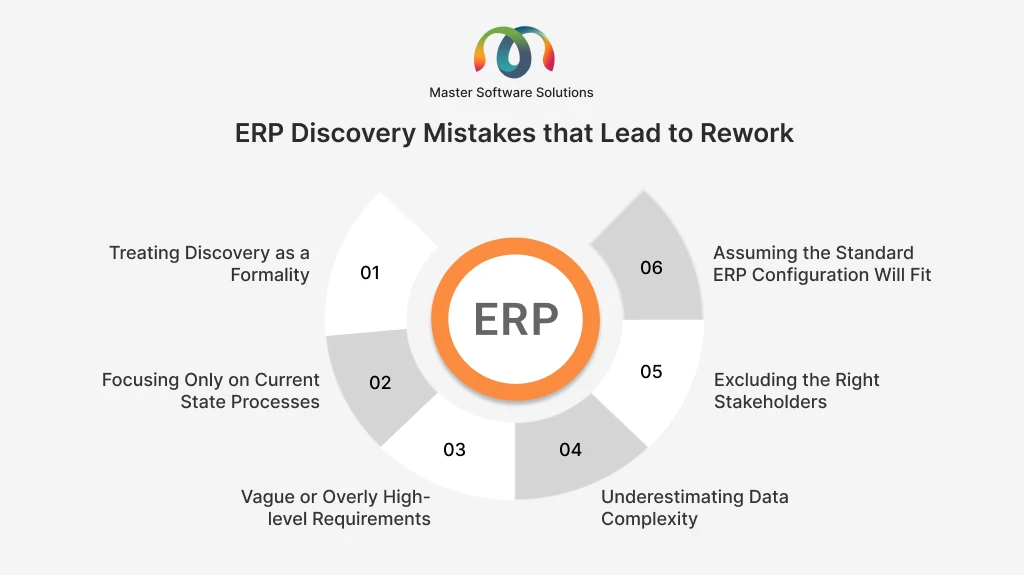
Vague or overly high-level requirements
Statements like “the system should support reporting” or “users need flexibility” leave too much open to interpretation. Ambiguity in discovery almost guarantees clarification and rework during implementation.
Underestimating data complexity
Data quality, ownership, and migration rules are often addressed too late. When data issues are identified during testing, teams are forced to revisit mappings, transformations, and validation logic.
Excluding the right stakeholders
When end users, decision-makers, or technical owners are not present during discovery, approvals are granted too late, resulting in reversals, late feedback, and misaligned expectations.
Assuming the standard ERP configuration will fit
Relying on “out-of-the-box” defaults without validating them against real business scenarios often leads to customization or redesign after the implementation has started.
The common thread is not speed; it is missed decisions. A disciplined discovery phase forces clarity early, reducing rework and keeping the ERP projects on track.
What does a high-quality discovery phase include?
A high-quality discovery phase is not about producing more documentation; it is about enabling better decisions early. It creates clarity before configuration begins, removing uncertainty that leads to rework later. Here is what it consistently includes.
Clear business objectives
Discovery begins with understanding why the ERP is being implemented. Success metrics, priorities, and constraints are defined upfront, ensuring that design decisions support business outcomes rather than assumptions.
Current-state and future-state process design
Teams go beyond documenting how work is done today. They define how processes should work in the ERP, identifying improvements, standardization opportunities, and required changes.
Well-defined, testable requirements
Requirements are specific enough to guide configuration and testing. Ambiguity is removed early, reducing interpretation and rework during the implementation.
Data and integration readiness
Data sources, ownership, quality issues, and migration scope are assessed before implementation. Key integrations and dependencies are identified and validated.
Stakeholder participation and decision ownership
End-users, business leaders, and technical teams are actively involved. Decisions are documented, trade-offs are acknowledged, and ownership is clearly assigned.
Realistic scope and delivery plan
Discovery produces a prioritized backlog and an implementation roadmap grounded in reality, not optimism. Risks and assumptions are visible and not hidden.
How does proper ERP discovery save hours of rework?
Proper ERP discovery saves time by forcing clarity before work begins. When teams take the time to understand processes, data, and decisions upfront, they avoid fixing problems later, when fixes are slower, more expensive, and more disruptive. Here is how it works, in simpler terms.
Fewer “We didn’t think of that” moments
Discovery brings hidden issues to the surface early. Teams walk through real scenarios, edge cases, and exceptions before configuration starts. This prevents surprises during testing that would otherwise require redesign and rebuilding.
Clear decisions reduce backtracking
When key decisions are made and documented during discovery, teams do not revisit them later. Without discovery, implementation often involves guessing, and guessing leads to backtracking once stakeholders see the system in action.
Less reconfiguration during implementation
Proper reconfiguration defines how the system should work before it is reconfigured. This avoids situations where modules are built, reviewed, rejected, and rebuilt. These are the biggest sources of wasted effort in ERP projects.
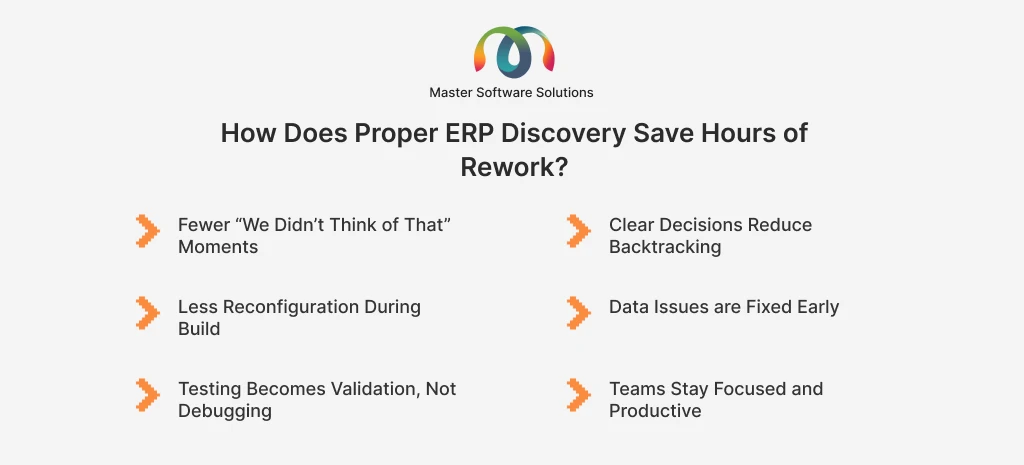
Data issues are fixed early
Discovery identifies data gaps, ownership issues, and quality problems upfront. Fixing data logic early is far easier than correcting it after integrations, reports, and tests are already in place.
Testing becomes validation, not debugging.
With solid discovery, testing confirms that the system works as designed. Without it, testing becomes a problem-finding exercise, forcing teams to pause, redesign, and retest repeatedly.
Teams stay focused and productive
Clear requirements and decisions allow delivery teams to move forward without constant interruptions. Less rework means fewer delays, fewer handoffs, and better momentum throughout the project.
ERP discovery phase: best practices
The ERP discovery phase sets the foundation for the entire implementation. When done well, it prevents rework, controls scope, and aligns business and delivery teams. The following best practices ensure a successful ERP implementation process.
Treat discovery as a decision-making phase
Discovery is not about gathering information for later use, but a place where key decisions must be made. Teams should explicitly identify decisions required (process design, data scope, integrations, customizations) and ensure each one has an owner and a documented outcome.
Best practice: End discovery with fewer open questions.
Start with business outcomes, not system features
Begin your discovery process with clear business goals, efficiency gains, scalability, compliance, visibility, or cost reduction. These goals guide process design and prevent feature-driven decisions that add complexity without value.
Best practice: Tie every major requirement to a business outcome.
Design the future state, not just document the current state
While understanding current processes is important, replicating them in a new ERP often locks in inefficiencies. High-quality discovery focuses on how processes should be in the future, using ERP standards where possible.
Best practice: Use current-state analysis as input, not the final design.
Involve the right stakeholders early
Stakeholders in the discovery phase include process owners, users, data owners, information technology, and decision-makers. Missing stakeholders lead to late feedback and reversals during implementation.
Best practice: Ensure each functional area has both a subject-matter expert and a decision authority involved.
Make requirements specific and testable
Vague requirements cause misinterpretation. Effective discovery translates needs into clear statements that guide configuration, customizations, and integrations.
Best practice: If a requirement cannot be tested, it is not ready.
Address data early and honestly
Data is often the most underestimated risk. Discovery should assess data quality, migration scope, ownership, transformation rules, and historical data needs before the implementation begins.
Best practice: Treat data readiness as a gating item, not a downstream task.
Validate assumptions with real scenarios
Assumption drives rework. Walking through realistic use cases, edge cases, and exceptions during discovery reveals gaps that high-level discussions miss.
Best practice: Instead of just interviews, hold scenario-based discussions.
Align on scope and trade-offs explicitly
Discovery should surface what will not be included, along with the rationale. Unspoken scope assumptions often turn into change requests later.
Best practice: Document trade-offs and decisions, not just requirements.
Produce actionable deliverables
Discovery outputs should directly support implementation, such as:
- Future-state process designs
- Prioritized requirements backlog
- Data migration and integration strategy
- Realistic implementation roadmap
Best practice: If a deliverable does not guide implementation or testing, reconsider its value.
Validate and sign-off before moving forward
Discovery findings must be reviewed and agreed upon by stakeholders before implementation starts. This creates accountability and reduces late-stage reversals.
Best practice: Do not start the implementation with unresolved discovery items.
Why partner with Master Software Solutions?
ERP success starts with making the right choice early. Master Software Solutions is an ERP consulting company that helps organizations initiate a clear, structured discovery phase to remove confusion and prevent rework later. We work closely with your team to understand your processes, clarify requirements, and identify risks before implementation begins.
Now, are you ready to avoid rework and keep your ERP project on track? Get in touch with us to start your ERP discovery with implementation the right way.