Planning an Odoo migration often begins with one key question: What will it cost?
The answer depends on several factors, including your current system, level of customization, data complexity, and target Odoo version. Without proper estimation, migration projects can face budget overruns and unexpected risks.
This blog breaks down Odoo migration costs, explains the key pricing factors, and outlines how to accurately estimate your budget, helping you plan a smooth, cost-effective migration.
Table of Contents
Why is it important for businesses to estimate migration costs?
Estimating migration costs is crucial because it enables businesses to plan the project realistically and avoid financial and operational risks. A clear cost estimate helps set an appropriate budget, allocate resources effectively, and prevent unexpected expenses during the migration process.
Accurate estimation aligns the migration scope with business goals, timelines, and ROI expectations, supporting better decision-making. Without it, organizations may face project delays, scope shortening, or compromises in quality and performance after going live.
Why do Odoo migration costs vary?
Odoo migration costs do not follow a fixed model because every implementation is based on a unique business and technical environment. The scope of migration, system complexity, and operational requirements differ from one organization to another, which directly impacts the total effort and cost involved. Reasons Odoo ERP migration costs vary are.
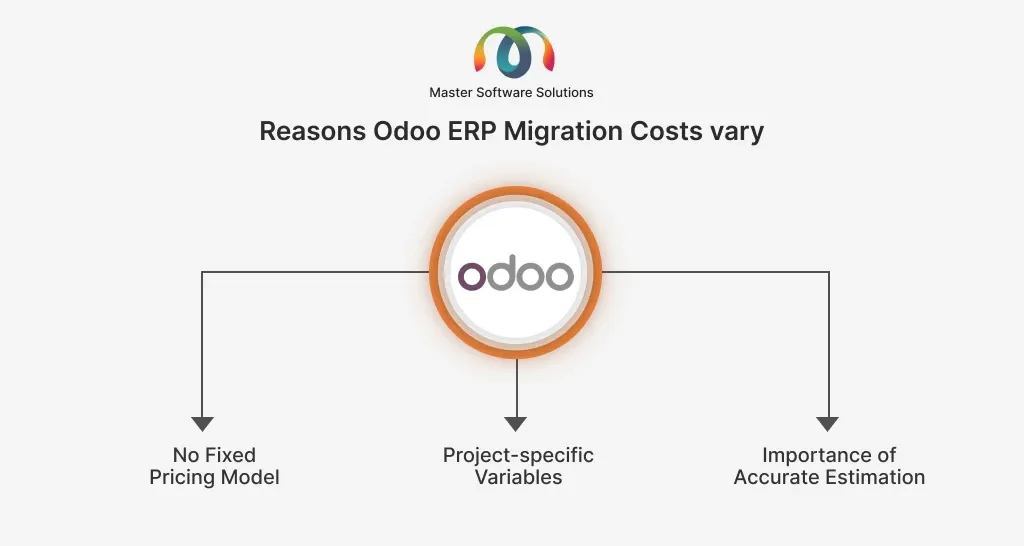
No fixed pricing model
Odoo migration includes assessing current configurations, custom modules, integrations, and data structures, unlike standard software upgrades. Each of these elements requires a tailored approach, making it impractical to apply a flat or predefined price across projects.
Project-specific variables
Migration costs are influenced by variables (the current and target Odoo version), number of modules, level of customization, data volume, and third-party integrations. Additional considerations, such as testing depth, deployment strategy, and acceptable downtime, further affect timelines and resource requirements.
Importance of accurate estimation
Accurate cost estimation sets realistic budgets, controls project scope, and reduces the risk of unexpected expenses or delays. Additionally, it identifies cost drivers early on to enhance planning, enabling companies to make better decisions and guarantee a successful and seamless migration.
Key factors that affect Odoo migration costs
Several technical and business factors influence the cost of an Odoo migration. Understanding these factors helps organizations plan budgets accurately and avoid unexpected expenses.
Factors that influence the costs of Odoo ERP migration are
- Current and target Odoo version: The greater the difference between the two, the more effort is required due to changes in features, data models, and APIs.
- Number of modules: The total number of modules in use, especially custom modules, directly impacts migration effort, testing, and validation.
- Levels of customization: Custom workflows, reports, and business logic are frequently written or unoptimized, which increases development time and cost.
- Data volume and complexity: Migrating larger volumes of historical or transactional data, along with data cleanup and validation, adds to the overall cost.
- Third-party integrations: Integrations with external systems such as payment gateways, accounting tools, or logistics platforms may require redevelopment or reconfiguration.
- Migration methodology: Automated migrations are generally faster and more cost-effective, while manual or hybrid approaches require additional effort.
- Testing and quality assurance: Comprehensive testing, including regression testing and User Acceptance Testing (UAT), is essential to ensure system stability and accuracy.
- Downtime & deployment strategy: Requirements for minimal downtime, phased rollouts, or parallel systems increase planning and execution costs.
- Post-migration support and training: Ongoing support, performance optimization, and user training after go-live contribute to the total cost of migration.
Also Read: Factors to Consider the Right Partner for Your Odoo 19 Migration and Upgrade
Key components of Odoo migration cost
Odoo migration costs are not limited to a single activity but are spread across multiple phases of the project. Each phase requires different levels of effort, technical expertise, and time investment. Understanding this cost breakdown helps businesses identify where resources are allocated, anticipate potential challenges, and plan a realistic migration budget without unexpected overruns. Here is the detailed Odoo migration cost breakdown.
Odoo licenses
Odoo licensing costs apply when migrating to or upgrading within the Odoo Enterprise Edition. The expense is typically calculated per user and depends on the selected applications and subscription plan. Licensing fees are recurring and should be factored into long-term budgeting, especially for businesses planning to scale users or modules after migration.
Hosting
Hosting costs depend on how and where Odoo is deployed. Options include Odoo online, Odoo.sh, or on-premise/cloud hosting through third-party providers. Factors such as server size, performance requirements, storage needs, security, backups, and uptime expectations influence hosting expenses. Higher availability and scalability requirements generally result in higher costs.
Pre-migration analysis and planning
This phase involves evaluating the existing Odoo system to understand current modules, customizations, data structure, and integrations. It includes identifying migration risks, defining the scope, selecting the migration approach, and creating a detailed roadmap. Proper planning helps prevent scope creep, unexpected costs, and downtime during Odoo ERP migration.
Data migration
Data migration covers the extraction, cleaning, transformation, and loading of business data into the Odoo version. This includes master data, transactional records, and historical data. The cost depends on data volume, data quality, and validation requirements to ensure accuracy and consistency after migration.
Module and customization migration
This stage focuses on migrating standard and custom modules. While standard modules are relatively straightforward, custom modules often require code refactoring or redevelopment to align with the target Odoo version. The level of customization affects development time, testing effort, and overall cost.
Integration reconfiguration
Existing integrations with third-party systems, such as payment gateways, accounting tools, CRMs, or logistics platforms, must be reconfigured or rebuilt. Changes in APIs or workflows in newer Odoo versions can increase complexity, making this a notable cost factor.
Testing and validation
Testing ensures that the migrated system functions correctly and meets business requirements. This includes functional testing, regression testing, performance testing, and user acceptance testing (UAT). Comprehensive testing reduces the risk of post-go-live issues but requires additional time and resources.
Go live and post-migration
The go-live phase includes final deployment, monitoring system performance, and resolving any immediate adjustments. Post-migration support encompasses bug fixes, performance optimizations, user support, and minor adjustments following launch. Adequate support ensures system stability and smoother user adoption.
Estimated cost range for Odoo migration
The estimated cost of an Odoo migration depends on your business size, customizations, data complexity, and integration needs. While actual prices vary by region and partner, the following ranges are commonly observed in real-world Odoo projects.
Small business/basic migration
For companies with few users, minimal custom modules, and standard processes, migration costs typically fall between $3k and $20k. It covers the core module migration, basic data transfer, and standard workflow validation.
Mid-size companies/moderate complexity
For businesses with moderate customization, several third-party integrations, complex workflows, and rigorous testing requirements. They may range between 20k and 75k, which includes custom module adaptation, moderate data cleanup, integration reconfiguration, and more extensive testing.
Large enterprises/high complexity
For organizations with heavy custom code, multiple integrations, complex workflows, and rigorous testing requirements. It ranges from $75k to $150k, covering full customization, refactoring, advanced integrations, multi-company setup, and extended support.
Note:
- Hourly rates for professional migration services range from $75 to $150 + per hour, depending on your partner’s expertise and region.
- While complex scenarios can cost more than $100k, simple version-to-version migrations (from Odoo 18 to Odoo 19) may start at $5k or $150k.
Hidden costs to consider in Odoo migration
While core migration activities are usually planned and budgeted, several indirect or overlooked costs can significantly impact the total migration expense. Identifying hidden costs early helps businesses avoid budget overruns and post-go-live disruptions. When migrating to Odoo, consider the following hidden costs.
Data cleanup and preparation
Legacy systems often contain duplicate, outdated, or inconsistent data. Cleaning and validating data before migration requires additional time and effort that is frequently underestimated but critical for system accuracy.
Rework due to scope changes
Unclear requirements or last-minute changes can lead to scope creep, requiring redevelopment, retesting, and additional project time.
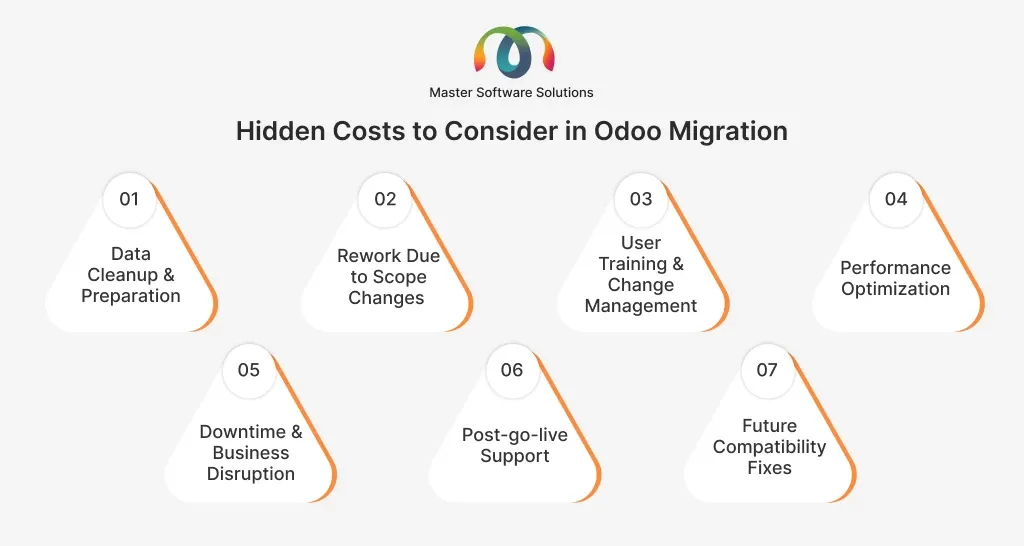
User training and change management
New Odoo versions often introduce UI and workflow changes. Training sessions, paperwork, and lost productivity during the shift may result from managing the adoption and training of users, and also add to expenses.
Performance optimization
After migration, performance tuning may be required to handle real-world workloads. Optimizing database performance, server resources, and custom code can add unplanned costs.
Downtime and business disruption
Even short periods of downtime during migration can impact operations, sales, or customer service. Businesses may incur indirect costs due to delayed transactions or reduced productivity.
Post-go-live support
Bug fixes, configuration adjustments, and user support immediately after deployment are more extensive than expected and may require additional support hours.
Future compatibility fixes
Some customizations or integrations may require further updates after migration to remain compatible with future Odoo updates, adding long-term maintenance costs.
How to reduce Odoo migration costs?
Reducing Odoo migration costs requires careful planning, scope control, and the right technical approach. Addressing potential cost drivers early helps businesses to lower both upfront and long-term expenses.
Clean and prepare data before migration
Remove duplicate, outdated, or irrelevant records before migration. Clean data reduces migration effort, validation time, and post-migration issues.
Limit unnecessary customization
Evaluate existing customizations and retain only those that add clear business value. Replacing custom features with standard Odoo functionality lowers development and maintenance costs.
Migrate only essential data
Excessive historical data shouldn’t be moved unless it’s required for compliance or reporting. Obtaining historical data independently can lower the cost and complexity of migration.
Choose the right migration approach
Automated or script-based migrations are generally more cost-effective than manual methods, especially for modules and data structures.
Plan thoroughly before execution
A detailed pre-migration analysis helps define the scope, identify risks, and prevent costly rework or scope creep during the project.
Optimize modules and integrations
Review existing modules and third-party integrations and remove unused or redundant ones to reduce development and testing effort.
Conduct early and continuous testing
Testing issues early in the process minimizes rework and avoids expensive fixes after go-live.
Work with an experienced Odoo migration partner
An experienced Odoo partner, such as Master Software Solutions, brings proven tools, best practices, and technical expertise, reducing project duration, risks, and unexpected costs.
Why work with an Odoo migration partner, like Master Software Solutions?
When properly planned and carried out, Odoo migration is a strategic investment that can enhance system performance, scalability, and business efficiency. As outlined in this blog, migration costs are influenced by multiple factors, including data complexity, customizations, integrations, licensing, and hidden post-go-live expenses. Without the right expertise, these costs escalate and put your project at risk.
Master Software Solutions, with its proven experience in Odoo migration across industries, follows a structured, risk-controlled approach that ensures accurate cost estimation, minimal downtime, and long-term system stability. We focus on optimizing existing customization, protecting data integrity, and aligning the migration with your business goals, guaranteeing maximum ROI without unnecessary expenses.
Contact us today for a detailed migration assessment and cost estimate. Let our Odoo experts help you migrate smartly, faster, and cost-effectively.