ERP systems were originally designed to manage core business transactions such as finance, supply chain, and human resources. While they helped standardize processes and improve efficiency, traditional ERP systems are mostly rule-based and reactive. They stored large amounts of data but provided limited decision-making intelligence.
As business environments become more complex and fast-moving, this approach is no longer sufficient. Integrating Artificial Intelligence (AI) with ERP systems can help move beyond data processing to deliver predictive insights, automation, and real-time decision support. AI-powered ERP enables a shift from systems of record to intelligent platforms that actively support modern business needs.
Table of Contents
Rising AI adoption in enterprises
In 2026, technology has become more reliable and easier to use, leading to more companies using AI than ever before. Businesses have started realizing how AI is improving efficiency, reducing manual work, and supporting better decisions. AI is no longer limited to small tests or pilot projects.
Now, AI is being built into core business systems such as ERP, CRM, and analytics platforms. This makes AI part of everyday work, helping automate tasks, improve productivity, and change how employees work. At the same time, businesses are investing in better data, skilled teams, and clear rules to make sure AI is used responsibly and at scale.
What is intelligent ERP?
Intelligent ERPs are traditional ERP systems that are enhanced with artificial intelligence (AI) technologies. While conventional ERP systems focus on recording, processing, and reporting data, intelligent ERP systems are designed to analyze data, learn from it, and support better decisions. They do not just tell you what happened; they also help explain why it happened and what to expect next.
In an intelligent ERP system, AI capabilities are embedded directly into core business processes such as finance, supply chain, manufacturing, HR, and procurement. This allows the system to automate routine tasks, detect patterns, predict outcomes, and provide recommendations to the users.
AI capabilities that enhance ERP systems
AI adds intelligence to ERP systems, enabling them to predict outcomes, automate work, simplify user interactions, and support better decisions. These capabilities turn ERP from a system that only records data into one that actively helps businesses operate more effectively.
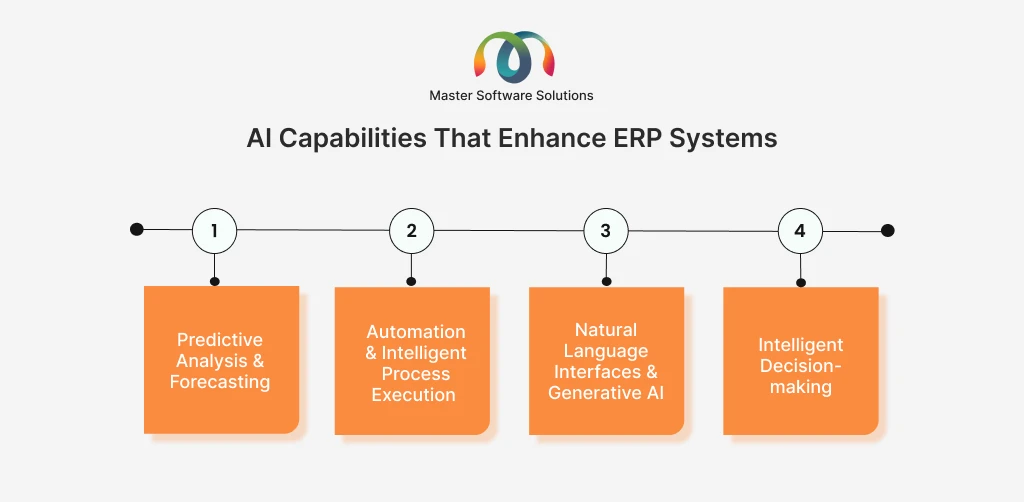
Predictive analysis and forecasting
Predictive analysis uses past and current data to estimate what is likely to happen in the future. Here is how predictive analysis and forecasting help.
- Demand forecasting: AI analyzes historical sales data, seasonal trends, and market signals to predict future customer demand. This helps businesses plan production and inventory more accurately, reducing shortages and overstock situations.
- Inventory optimization: Based on demand forecasts and supply chain data, AI recommends optimal inventory levels. It helps organizations maintain the right amount of stock at the right location, lowering storage costs while ensuring product availability.
- Financial planning and risk prediction: AI supports financial teams by forecasting cash flow, revenue, and expenses. It can also identify potential financial risks, such as late payments or budget overruns, allowing businesses to take corrective action early.
Automation and intelligent process execution
AI improves automation by making ERP processes more flexible and intelligent. Here are the automation and intelligent process-execution capabilities the AI-driven ERP offers.
- AI-driven workflows: AI can automatically route tasks, approvals, and actions based on real-time data. For example, it can prioritize urgent purchase requests or automatically approve low-risk transactions.
- RPA + AI for end-to-end automation: Robotic Process Automation (RPA) handles repetitive tasks such as data entry or invoice processing. When combined with AI, these bots can handle exceptions, understand unstructured data, and complete entire processes with minimal human involvement.
- Exception handling and self-healing processes: AI can detect errors or unusual situations in business processes and take corrective action. For example, if a transaction fails or data is missing, the system can automatically fix the issue or alert the appropriate user, reducing delays and manual effort.
Natural Language Interfaces and generative AI
Natural language and generative AI make ERP systems easier to use and more accessible. Here is how they do it.
- Conversational ERP (chatbots & copilots): Users can interact with ERP systems through chat interfaces, asking questions or requesting actions in simple language. For example, a user can ask, “Show today’s sales numbers” or “create a purchase order.”
- Natural language queries for reports: Instead of building complex reports, users can ask questions in plain language. The ERP system understands the request and returns relevant data or dashboards instantly.
- AI-generated insights, summaries, and recommendations: Generative AI can summarize reports, explain trends, and suggest next steps. This helps users quickly understand complex data without great technical and analytical skills.
Intelligent decision-making
AI helps decision-makers act faster and with more confidence. Here is how an AI-driven ERP system helps businesses make intelligent decisions.
- Real-time insights and alerts: AI continuously monitors data and sends alerts when anything needs attention, such as cost spikes, supply delays, or performance issues. This allows teams to respond before problems escalate.
- Scenario modeling and simulations: AI enables businesses to test different “what-if” scenarios. For example, leaders can see how changes in demand, pricing, or supply disruptions might affect revenue or profitability.
- Augmented decision-making for executives: Instead of replacing human judgment, AI supports it by providing data-driven recommendations. Executives receive clear insights, risks, and options, helping them make informed strategic decisions.
AI use cases across core ERP functions
AI enhances ERP systems by improving how different business functions operate. Instead of relying only on fixed rules and manual analysis, AI helps ERP systems learn from data, predict outcomes, and automate routine work.
Finance and accounting
AI-driven ERP systems improve finance and accounting accuracy and reduce risk. AI can automatically detect unusual transactions or patterns that may indicate error or fraud. This enables finance teams to identify issues early rather than during audits and reviews.
AI also simplifies reconciliations and the financial close process. Tasks such as matching invoices, payments, and ledger entries can be automated, reducing manual effort and speeding up month-end and year-end closing activities.
Supply chain and manufacturing
In the supply chain and manufacturing, AI helps organizations to plan better and avoid disruptions. Predictive maintenance uses AI to analyze equipment data and predict when machines are likely to fail. This allows companies to fix issues before breakdowns occur, reducing downtime and maintenance costs.
AI also supports demand-driven supply planning by forecasting accurate customer demand. Based on these forecasts, ERP systems can recommend optimal inventory levels and production plans, helping businesses avoid shortages or excess stock.
Human Capital Management (HCM)
In HCM, AI helps manage talent more effectively. AI can match candidates to job roles by analyzing skills, experience, and past performance data. This improves hiring decisions and helps place employees in roles where they aremost likely to succeed.
AI can also predict employee churn by identifying patterns that can indicate the risk of your employees leaving. This also helps HR teams to take early actions, such as improving engagement or addressing workload issues.
Sales, procurement, and CRM integration
AI can help improve decision-making across sales and procurement functions. Dynamic pricing uses AI to adjust prices based on demand, market conditions, customer behaviour, and competition. This helps businesses remain competitive while maximizing revenue.
In procurement, AI supports intelligent sourcing by analyzing supplier performance, pricing trends, and delivery history. It can also assess vendor risk by identifying suppliers that may face financial, operational, or compliance issues, helping organizations make safer sourcing decisions.
Business benefits of AI-driven ERP systems
AI-driven ERP systems help organizations work smarter by improving efficiency, decision-making, accuracy, and usability. Instead of only managing data, these systems actively support daily operations and business goals.
Improved operational efficiency
AI automates repetitive and time-consuming tasks such as data entry, invoice processing, approvals, and reconciliations. This reduces manual efforts and speeds up business processes. AI can also optimize workflows by identifying bottlenecks and suggesting better ways to complete tasks. As a result, teams can focus more on strategic, value-added work.
Faster and higher-quality decision-making
AI analyzes large volumes of data in real-time and turns it into meaningful insights. Instead of waiting for reports, decision-makers receive timely alerts, forecasts, and recommendations. This helps leaders respond quickly to changes, evaluate different scenarios, and make more informed decisions based on data rather than intuition.
Reduced costs and errors
By automating processes and continuously monitoring data, AI helps reduce human errors such as duplicate entries, incorrect transactions, or missed approvals. AI can also detect unusual patterns that may indicate fraud, waste, or inefficiencies. These capabilities help lower operational costs, avoid financial losses, and improve overall accuracy.
Enhanced user experience and adoption
AI makes ERP systems easier to use by allowing users to interact through natural language, chatbots, or guided recommendations. Employees no longer need deep technical knowledge to access data or perform tasks. A simpler and more intuitive experience increases user adoption, improves productivity, and ensures that ERP systems deliver maximum value across the organization.
AI-driven ERP implementation considerations and challenges
While AI can deliver significant value in ERP systems, successful adoption requires careful planning. Organizations must address several practical and organizational challenges to ensure AI works reliably and is trusted by users.
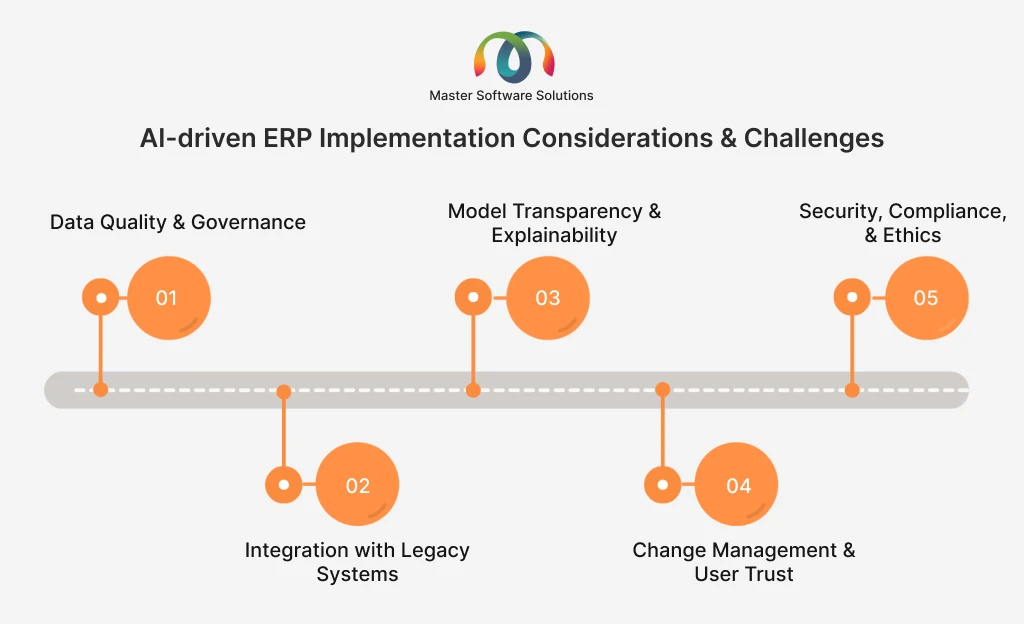
Data quality and governance
AI depends heavily on data. If ERP data is incomplete, inaccurate, or inconsistent, AI outputs will also be unreliable. Poor data quality can lead to incorrect predictions, faulty automation, and loss of trust in the system.
Data governance is equally important. Organizations need clear rules for how data is collected, stored, updated, and used. This includes defining data ownership, ensuring consistency across systems, and maintaining data accuracy over time. Strong data governance provides a solid foundation for AI-driven ERP.
Integration with legacy systems
Many enterprises still rely on older ERP systems or custom-built applications. Integrating AI with these legacy systems can be complex and time-consuming.
Legacy systems may lack modern APIs or standardized data structures, making it difficult for AI tools to access and process data. Organizations often need middleware, system upgrades, or phased modernization approaches to ensure AI can work smoothly across the existing IT landscape.
Model transparency and explainability
AI models often operate as “black boxes,” making it difficult to understand how they arrive at specific decisions or recommendations. This lack of transparency can be a problem, especially in areas like finance, HR, and compliance.
Enterprises need AI models that can explain their outputs in simple terms. Explainable AI helps users understand why a recommendation was made, builds confidence in the system, and supports regulatory and audit requirements.
Change management and user trust
Introducing AI into ERP systems changes how people work. Employees may be hesitant to trust AI recommendations or fear job displacement.
Effective change management is critical. This includes clear communication about the role of AI, training users on how to work with AI tools, and positioning AI as a support system rather than a replacement. When users understand and trust AI, adoption and value realization increase significantly.
Security, compliance, and ethics
AI-powered ERP systems handle sensitive business and personal data. This makes security a top priority. Organizations must protect data from breaches, unauthorized access, and misuse.
Compliance is also critical, especially with regulations related to data privacy, financial reporting, and labor laws. Ethical considerations include avoiding bias in AI models, ensuring fair decision-making, and using AI responsibly. Strong security controls, compliance frameworks, and ethical guidelines help reduce risk and protect organizational trust.
Leading ERP systems and their AI strategy
Many major ERP vendors are adding AI capabilities to make their systems smarter, more automated, and easier to use. Each platform approaches AI slightly differently, but the goal is the same: help businesses work more efficiently and make better decisions.
Odoo (AI-enhanced Open-source ERP)
Odoo is an open-source ERP platform that is increasingly adding AI features to improve usability and automation. Odoo uses AI for tasks such as document processing, invoice scanning, demand forecasting, and customer communication.
AI-powered chatbots, smart recommendations, and automation tools help small and mid-sized businesses reduce manual work. Odoo’s modular and flexible design allows organizations to adopt AI features gradually, making it accessible for companies with limited budgets or simpler requirements.
Microsoft Dynamics (Azure, Copilot)
Microsoft integrates AI into Dynamics 365 using Copilot and Azure AI. Copilot is an AI assistant that helps users create reports, analyze data, draft emails, and get insights directly within ERP and CRM workflows.
Because Dynamics 365 is closely connected to Microsoft tools like Excel, Outlook, and Teams, AI-powered ERP capabilities fit naturally into everyday work, improving productivity and collaboration.
Bottom line
AI is transforming ERP systems from basic transaction tools into intelligent platforms that support automation, insights, and better decision-making. As enterprises continue to adopt AI in 2026 and beyond, intelligent ERP systems are becoming essential for improving efficiency, reducing costs, and staying competitive in a fast-changing business environment.
Master Software Solutions helps businesses navigate this transformation by delivering end-to-end ERP implementation services. From consulting and system design to customization, integration, and ongoing support, MSS ensures that ERP systems are aligned with business goals and ready to leverage AI effectively.
Master Software Solutions specializes in building AI-powered custom ERP solutions using leading platforms such as Odoo and Microsoft Dynamics 365. By combining these flexible ERP platforms with AI capabilities, MSS helps organizations automate processes, gain real-time insights, and create ERP systems tailored to their unique operational needs.
If you are planning to modernize your ERP or adopt an AI-driven ERP solution, we can help you at every step of the journey. Contact us today.