Ensuring product safety, consistency, and regulatory compliance is mandatory in the dairy industry to comply with regulations. Dairy manufacturers must maintain visibility over their operations to meet strict food safety standards and rising consumer expectations, from milk procurement and processing to final distribution. Any gap in traceability or quality control can lead to costly recalls, compliance failures, and reputational damage.
This is where dairy ERP software plays a critical role. The system centralizes data across procurement, production, quality testing, and distribution to achieve end-to-end traceability. This blog discusses how dairy ERP solutions can help dairy processors improve traceability, strengthen quality management, and ensure resilient and compliant operations.
What is dairy product traceability?
Dairy product traceability refers to the ability to track and document every stage of a dairy product’s journey, from raw milk collection at the farm to processing, packaging, storage, distribution, and final sale. It provides farm-to-fridge visibility, ensuring that every movement, transformation, and quality checkpoint is recorded and can be accessed easily.
There are three critical questions involved in dairy traceability:
- Where did the milk come from? (farm, supplier, or collecting center)
- What happened to it? (processing steps, quality tests, and conversions)
- Where did it go? (warehouse, distributor, retailer, and consumer)
How does ERP help achieve dairy product traceability?
The dairy industry requires a great level of visibility to maintain food safety, regulatory compliance, and operational accountability across the dairy supply chain. This traceability is achieved through systematic batch and lot tracking at each operational stage. You can assign unique identifiers to milk collections, production runs, and finished goods. This enables batch tracking and creates a structured data chain that connects raw materials, process parameters, and quality outcomes. The importance of batch and lot tracking for dairy products such as milk, cheese, yogurt, & fermented products.
Milk: Each collection batch can vary in fat content, SNF, temperature, and microbial levels. Tracking batches ensures only compliant milk enters production and allows issues to be traced back to specific suppliers or collection routes.
Cheese: Production involves multiple stages, like culturing, aging, and packaging. Lot tracking links raw milk batches to processing parameters, aging conditions, and final product lots, ensuring quality consistency and accountability over long maturation periods.
Yogurt & fermented products: These products are sensitive to fermentation time and temperature. Batch-level tracking helps monitor the process deviations, maintain product consistency, and quickly isolate affected lots if a quality issue arises.
Effective batch and lot tracking enables:
- Quick identification and isolation of affected products during recalls.
- Reduces financial and reputational risk.
- Improved audit readiness and regulatory compliance.
- Greater transparency and trust across the supply chain.
What is quality control in the dairy industry?
Quality control in the dairy industry refers to continuous processes and checks used to ensure that dairy products consistently meet defined safety, quality, and regulatory standards. Dairy products are highly perishable and can impact consumer health, so quality control must be implemented throughout the production cycle. At its core, dairy quality control focuses on preventing contamination, maintaining product consistency, and ensuring compliance with food safety regulations.
Key quality parameters in dairy processing
Continuous monitoring of critical parameters drives quality control that determines product safety and acceptability:
Fat content: Ensures product standardization and labeling accuracy for items such as milk, butter, and cream. Variations can affect taste, texture, and regulatory compliance.
SNF (Solids-Not-Fat): Includes proteins, lactose, and minerals. Maintaining correct SNF levels is crucial for nutritional value, optimizing yield, and adherence to industry standards.
Temperature: Strict temperature control during milk collection, storage, processing, and transportation is critical to prevent microbial growth and product standards.
Microbial levels: Parameters such as total plate count, somatic cell count, and pathogen presence directly indicate milk hygiene and safety. Elevated microbial levels can make products unsafe and noncompliant.
Role of inspections, testing, and compliance
To control these parameters effectively, dairy manufacturers rely on structured quality assurance practices:
Inspections: Routine inspections of raw milk, processing equipment, storage facilities, and packaging operations help identify hygiene issues, equipment failures, or process deviations early.
Testing: Laboratory testing, both in-house and third-party, validates quality parameters at defined checkpoints. These tests provide objective data to approve, reject, or reprocess batches.
Compliance: Quality control ensures adherence to food safety regulations and standards, including the FSSAI, FDA, HACCP, ISO, and local dairy authority requirements. Accurate documentation and traceability are essential for audits and regulatory reporting.
Challenges in traditional dairy traceability and quality management
Despite its critical importance, dairy traceability and quality management are often handled through manual or semi-digital processes in dairy operations. These legacy or outdated approaches create multiple operational and compliance challenges, especially as regulatory requirements and production volumes increase. Here are the challenges in traditional dairy traceability and quality management.
Manual record-keeping and data silos
Many dairy businesses rely on paper registers, spreadsheets, or disconnected software systems to record procurement, production, and quality data. This results in fragmented information that is difficult to consolidate, analyze, or retrieve during audit investigations.
Limited end-to-end visibility
Traditional systems lack real-time visibility across the dairy value chain. Tracking milk from farm collection to finished goods often requires manual reconciliation, making it difficult to trace product movement accurately or identify the root cause of quality issues.
Delayed responses to quality deviations
Quality issues such as temperature breaches, microbial failures, or process deviations are often detected late due to delayed data entry or reporting. This reactive approach increases the risk of large-scale product rejections, rework, or recalls.
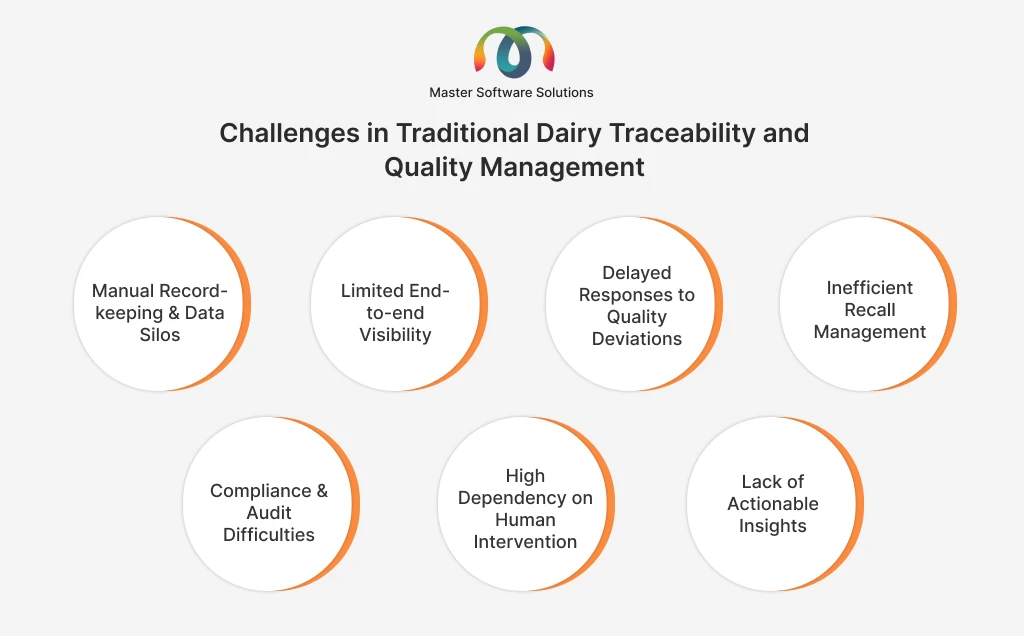
Inefficient recall management
Without automated batch and lot tracking, identifying affected products during a recall can be time-consuming and prone to errors. This frequently results in broader recalls than necessary, higher financial losses, and higher reputational risk.
Compliance and audit difficulties
Regulatory audit requires accurate, complete, and readily accessible documentation. Traditional systems make it challenging to produce consistent records, increasing the likelihood of non-compliance findings, penalties, or operational disruptions.
High dependency on human intervention
Manual processes increase the risk of data entry errors, missed quality checks, and inconsistent adherence to standard operating procedures. This dependency limits scalability and makes quality outcomes heavily reliant on individual experience rather than controlled systems.
Lack of actionable insights
Traditional traceability and quality systems focus on record-keeping rather than analysis. Without centralized data and reporting, dairy manufacturers struggle to identify trends, optimize processes, or proactively improve quality performance.
How do dairy ERP solutions improve product traceability?
Dairy ERP solutions improve product traceability by digitizing, integrating, and automating data across the entire dairy value chain. Instead of relying on disconnected records, an ERP system creates a single, reliable source of truth that enables end-to-end visibility, faster issue resolution, and regulatory compliance. Below are the key ways dairy ERP strengthens product traceability.
End-to-end batch and lot tracking
Dairy ERP systems assign a unique batch and lot number to raw milk, intermediate products, and finished goods. These identifiers remain linked throughout procurement, processing, packaging, storage, and distribution operations. This enables:
- Forward traceability (tracking where a batch was distributed).
- Backward traceability (identifying raw materials and suppliers for any finished product).
- Immediate isolation of affected batches during quality incidents or recalls.
Source-level traceability at farm and collection points
The ERP system enables source-level traceability, creating accountability at the source level and allowing manufacturers to trace quality issues back to specific farms, routes, or collection centers. ERP captures milk procurement data at the source, including:
- Farmer or supplier details
- Collection center information
- Quality parameters such as fat, SNF, temperature, and microbial results
Real-time data capture across operations
Dairy ERP integrates data from production, quality testing, inventory, and logistics in real time. This eliminates delays caused by manual entries and ensures that traceability data is always current and accurate. Real-time traceability helps:
- Detect deviation early.
- Prevent non-compliant batches from moving forward.
- Maintain continuous visibility across departments.
Automated recall management
During a quality issue, ERP enables rapid identification of affected products, customers, and distribution locations. Instead of recalling entire production runs, businesses can target specific batches or lots. This reduces:
- Recall time and scope
- Financial losses
- Regulatory and reputational risk
Integrated quality and compliance records
ERP systems link traceability data with quality inspections, lab results, and compliance documentation. Every batch contains its full history, making audits faster and more reliable. This supports compliance with:
- Food safety regulations (FSSAI, FDA, HACCP, & ISO).
- Internal quality standards and SOPs.
Centralized reporting and audit readiness
All traceability is stored in a centralized system along with standardized reports and dashboards. This allows instant retrieval of records for audits, certifications, and regulatory reviews.
How does dairy ERP implementation strengthen quality control?
Dairy ERP implementation improves quality control by integrating it directly into daily operations, resulting in consistent compliance and faster response to deviations. Ways dairy ERP strengthens product quality control.
Standardized quality processes and SOP enforcement
Dairy ERP system enforces predefined quality standards and standard operating procedures (SOPs) at every stage, including milk procurement, processing, packaging, and storage. Mandatory quality checkpoints and system validations ensure that no batch proceeds without meeting the required criteria. This reduces process variability while ensuring consistent product quality.
Real-time quality data capture and monitoring
ERP platforms capture quality parameters such as fat content, SNF, temperature, acidity, and microbial results in real-time, either through manual entry or integration with laboratory and IoT systems. Real-time visibility allows quality teams to:
- Identify deviations immediately.
- Take corrective action before issues escalate.
- Prevent non-compliant batches from entering the next process stage.
Automates quality alerts and exception management
When quality parameters fall outside acceptable limits, the ERP system triggers automated alerts. This alerts prompt predefined workflows for investigation, corrective actions, and approval. This proactive approach minimizes quality failures and supports continuous improvement.
Integrated quality testing and approval workflows
Dairy ERP integrates lab testing results directly with production batches. Batches can be automatically approved, rejected, or quarantined based on test outcomes, eliminating manual decision-making errors. This ensures that only compliant products move ahead in the supply chain.
Traceability-driven root cause analysis
Because quality data is linked to batch, supplier, process, and equipment information, ERP enables fast root cause analysis. The quality teams can determine whether a problem stemmed from raw milk quality, processing conditions, or handling practices. This reduces investigation time while increasing the effectiveness of corrective action.
Compliance, documentation, and audit readiness
The ERP system maintains complete digital records of inspections, test results, deviations, and corrective actions. This simplifies audits and ensures ongoing compliance with food safety standards, such as FSSAI, FDA, HACCP, and ISO.
Business benefits of implementing ERP-driven traceability and quality control
Implementing ERP-driven traceability and quality control delivers measurable business value beyond regulatory compliance. Integrating quality and traceability into core operations enables dairy businesses to gain stronger operational control, reduce risk exposure, and improve financial and brand performance. Here are the benefits of ERP-driven traceability and quality control in the dairy industry:
Reduced recall risk and cost
ERP-driven traceability enables rapid identification and isolation of affected batches. This precision significantly reduces the scope, duration, and cost of recalls while protecting brand reputation and customer trust.
Improved regulatory compliance and audit readiness
With centralized, digital records linked to every batch, audits become faster and more predictable. ERP ensures consistent adherence to food safety standards while reducing the risk of noncompliance penalties and operational disruptions.
Lower wastage and rework
Real-time quality monitoring and early deviation detection prevent defective batches from progressing through the production cycle. This reduces material loss, reprocessing costs, and unnecessary disposal of finished goods.
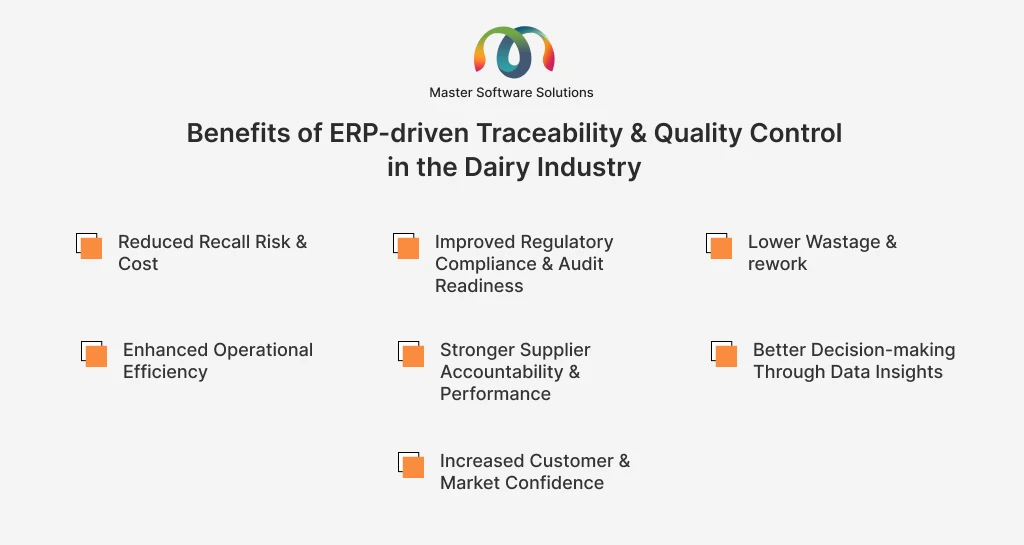
Enhanced operational efficiency
Automated data capture, standardized workflows, and integrated systems reduce manual effort and errors. Quality and traceability tasks that once required significant administrative time are streamlined, allowing teams to focus on value-added activities.
Stronger supplier accountability and performance
ERP links quality outcomes directly to suppliers, farms, and collection centers. This visibility enables performance benchmarking, fair decisions, and targeted supplier improvement programs.
Better decision-making through data insights
ERP-driven analytics provide actionable insights into quality trends, process stability, and supplier performance. Management can make informed decisions to optimize production, improve consistency, and reduce long-term risk.
Increased customer and market confidence
Demonstrable traceability and quality control foster customer confidence, support certifications, and open access to regulated or expert markets that demand high transparency and compliance standards.
Conclusion
Product safety, regulatory compliance, and consumer trust are critical, and dairy businesses can no longer rely on fragmented systems and manual systems to manage traceability and quality. ERP-driven traceability and quality control provide the structure, visibility, and automation needed to monitor every batch, enforce quality standards, and respond swiftly to deviations or recalls. Integrating procurement, production, quality testing, and distribution into a single platform enables you to change your traceability and quality management approach from reactive obligations to proactive, data-driven capabilities.
If your dairy operation is looking to strengthen traceability, enhance quality control, and ensure long-term compliance, now is the time to evaluate a dairy ERP system. Book a consultation call to explore how ERP can be tailored to your dairy operations.