Is your business outgrowing spreadsheets, disconnected systems, or manual processes? However, you are unsure whether ERP will deliver results.
Choosing an ERP is not just a software decision but a strategic commitment to elevating your entire operation. ERP implementation impacts every department, workflow, and data point in your organization. There are platforms like Odoo that promise flexibility, scalability, and cost efficiency; however, the right question is whether Odoo is a robust platform and how effectively it is implemented.
Many businesses invest in ERP systems only to face delays, budget overruns, or user resistance. The only factor that will make a difference between an ERP that accelerates growth and one that becomes an operational burden is Professional Implementation.
This blog examines why selecting the right Odoo implementation services is crucial for maximizing ROI, mitigating risk, and ensuring your ERP operates efficiently.
What is Odoo?
Odoo is an open-source enterprise resource planning platform that comprises multiple business applications, which can be added or removed based on the business’s unique requirements. The system is designed to help organizations manage and integrate their core business processes within a single system.
At its core, Odoo replaces fragmented tools and manual workflows with a unified, modular application suite that covers functions such as sales and Customer Relationship Management (CRM), accounting and finance, inventory and warehouse management, manufacturing and MRP, Human Resources and payroll, project management, purchasing and supply chain, and e-commerce and website management.
Why does Odoo ERP implementation fail without expert support?
Odoo implementation fails without expert support because ERP projects are not just technical exercises but complex business transformation initiatives. While Odoo is flexible and user-friendly, that flexibility introduces risk when it is not guided by experience and structured methodology. Below are the key reasons why Odoo implementations fail without expert support:
Incomplete or incorrect requirement analysis
Without expert guidance, businesses often focus on what they want the system to do rather than on how their processes should work. Experts translate business objectives into scalable Odoo Workflows before configuration begins. This leads to:
- Misaligned module selection
- Over-customization or under-configuration
- Critical business gaps that are discovered late in the project
Poor process design and workflow mapping
Odoo implementation is process-driven. Implementation specialists redesign processes to accommodate Odoo’s strengths rather than forcing the system to fit outdated workflows. Implementations fail when
- Existing inefficient processes are blindly replicated
- Cross-department dependencies are ignored
- Standard Odoo best practices are not leveraged
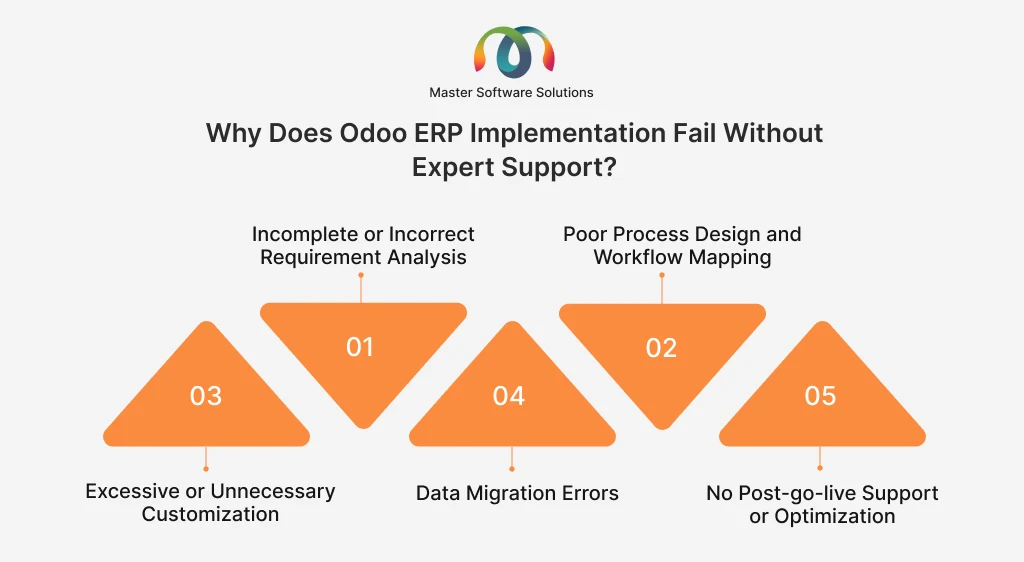
Excessive or unnecessary customization
- DIY implementations often rely on customization to the system work, resulting in:
- Higher development and maintenance costs
- Upgrade challenges
- System instabilityExperienced Odoo consultants prioritize configuration over customization, applying custom development only where it delivers measurable value.
Data migration errors
Data migration is one of the most underestimated risks. Professionals ensure data is cleansed, validated, and reconciled before going live. Without expert support:
- Inconsistent or duplicate data is migrated
- Historical data integrity is compromised
- Accounting and inventory discrepancies
No post-go-live support or optimization
ERP implementation doesn’t end once you have gone live. Professional implementation services include stabilization, monitoring, and continuous improvement. Without ongoing support:
- Minor issues escalate into major problems
- System performance degrades
- Business users revert to manual workarounds
What are Odoo implementation services?
Odoo implementation services are a structured set of professional services designed to plan, deploy, customize, integrate, and support the Odoo ERP platform. This ensures that the system aligns with the business’s processes and growth objectives. These services ensure that the implemented Odoo system is fully operational, scalable, and adopted by users.
At Master Software Solutions, we offer a comprehensive range of services, including.
Odoo implementation
This is the end-to-end deployment of Odoo ERP across business functions. The Odoo ERP implementation services include business process analysis and requirement gathering, module selection and system configuration, user roles, workflows, and access control setup, data setup, initial testing and user training, and go-live support. Professional Odoo implementation services ensure a stable and fully functional Odoo ERP system that is aligned with business operations.
Odoo ERP migration
Odoo migration services focus on upgrading or moving data and processes to a new Odoo version or platform. We help businesses with migrating from legacy ERP or accounting systems, Odoo version upgrades, and on-premise to cloud migration. Our Odoo ERP migration services ensure a seamless transition, avoiding data loss or business disruption.
Odoo customization
Customization adjusts Odoo to unique business needs beyond standard configuration. Our Odoo customization services offer custom workflows and approval rules, tailored reports and dashboards, UI/UX adjustments, and business-specific logic development.
Odoo consultation
At Master Software Solution, Odoo ERP consultation services involve strategic and functional guidance before and during implementation. We provide ERP feasibility and readiness assessments, process reengineering recommendations, Odoo vs. alternative ERP evaluations, an implementation roadmap, and cost estimates.
Odoo multi-platform integration
We offer Odoo multi-platform integration services that include connecting Odoo with external systems and applications. Common integrations include payment gateways, e-commerce platforms (Shopify, Magento, WooCommerce), logistics and shipping providers, and BI tools and third-party APIs.
Odoo website development
Odoo website development services use Odoo’s built-in CMS and e-commerce capabilities. The capabilities include Corporate websites and landing pages, e-commerce store setup and optimization, SEO-friendly content structure, and integration with CRM, inventory, and accounting.
Odoo module development
Odoo module development services involve creating custom apps. Industry-specific features, sophisticated reporting or automation, and compliance or regulatory requirements are a few examples of these improvements.
Odoo support and maintenance
They are ongoing services that ensure system stability and continuous improvement. Our Odoo support and maintenance services include debugging and performance optimization, version updates and security patches, functional enhancements, and user support and training refreshers.
Also Read: How to Choose the Right Odoo Implementation Company?
Key benefits of choosing professional Odoo implementation services
Implementing professional Odoo implementation services delivers measurable business value by reducing risk, accelerating deployment, and ensuring the ERP system supports long-term growth rather than creating operational friction. Below are the key benefits organizations gain by working with experienced Odoo implementation experts.
Faster and more predictable implementation
Professional Odoo implementation services follow proven methodologies and structured project plans, which significantly reduce uncertainty during deployment. Clear timelines, defined milestones, and experienced execution help organizations avoid delays and ensure the system goes live as planned, delivering faster time to value with minimal operational disruption.
Accurate requirement mapping and process alignment
Experienced Odoo consultants thoroughly understand your business’s objectives and operational workflows. Instead of simply replicating existing processes, they redesign and align them with Odoo best practices, ensuring the ERP system supports efficient, scalable, and future-ready operations.
Reduced implementation risk
When poorly managed, ERP implementations carry complicated operational and financial risks. Professional Odoo implementation services mitigate these risks through structured planning, controlled customizations, rigorous testing, and governance frameworks, reducing the likelihood of cost overruns, system failures, and post-go-live issues.
Optimal use of standard Odoo features
Odoo offers extensive out-of-the-box functionality that is often underutilized in self-led implementations. Professional consultants leverage standard modules wherever possible, minimizing unnecessary customization and ensuring the system remains stable, maintainable, and compatible with future upgrades.
High-quality data migration and integrity
Data migration is a critical success factor in any ERP implementation. Odoo experts ensure data is cleansed, accurately mapped, validated, and reconciled before going live, preserving data integrity and providing reliable financial, inventory, and operational reporting from day one.
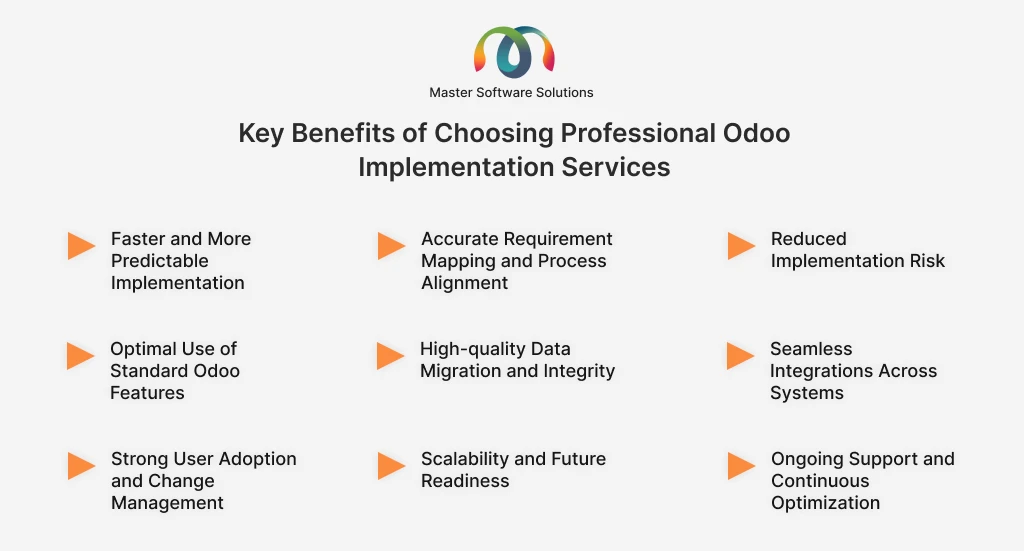
Seamless integrations across systems
Most businesses rely on multiple applications beyond their ERP. Professional Odoo implementation services design and implement secure, scalable integrations with CRM platforms, e-commerce systems, payment gateways, logistics providers, and legacy applications, enabling real-time data synchronization and unified operations.
Strong user adoption and change management
User resistance is a common reason ERP projects fail. Professional implementation teams address this by providing role-based training, clear documentation, and structured change management strategies, ensuring employees understand, adopt, and effectively use the Odoo system in their daily operations.
Scalability and future readiness
Professional Odoo implementations are designed with growth in mind. Consultants architect the system to support modular expansion, multi-company structures, and multi-country operations, ensuring the ERP can scale seamlessly as business needs evolve.
Ongoing support and continuous optimization
Odoo implementation does not end at go-live. Professional service providers, like Master Software Solutions, offer ongoing support, performance monitoring, and version upgrades, ensuring the ERP system continues to deliver value and adapt to changing business requirements over time.
In-house vs. partner-led Odoo implementation
When planning an Odoo ERP project, one of the first decisions businesses face is whether to manage the implementation internally or work with an experienced Odoo implementation partner. Each approach has its advantages, but the right choice depends on your resources, expertise, and long-term goals.
In-house Odoo implementation
In-house Odoo implementation means your internal team handles everything, from understanding business requirements to configuring the system and managing deployment. If you already have technical staff, this seems a cost-effective option. However, Odoo is a powerful and flexible platform, and without deep implementation experience, teams often spend significant time learning, troubleshooting, and reworking configurations. This can lead to longer timelines, system limitations, and unexpected costs after deployment.
Partner-led Odoo implementation
Partner-led Odoo implementation involves working with professionals who specialize in Odoo projects. These experts bring proven methods, real-world experience, and best practices gained from multiple implementations. They help map your business processes correctly, avoid unnecessary customization, and ensure the system is set up for both current needs and future growth. This results in projects moving faster, lowering risks. And confident use of the system.
From a cost perspective, in-house implementation may appear cheaper upfront, but delays, errors, and post-launch fixes often increase the overall cost. Partner-led implementations usually require a higher initial investment, but they reduce rework, improve system performance, and lower long-term maintenance expenses.
In terms of speed and reliability, internal teams typically face a learning curve, which can slow progress and increase risk. Implementation partners, on the other hand, follow structured processes and testing strategies, helping ensure a smoother and more predictable rollout.
In-house implementations are designed with scalability in mind. They support future expansion, integrations, and upgrades more easily, while in-house setups often focus on immediate requirements.
In summary, in-house implementation may work for smaller, less complex projects with experienced internal Odoo resources. For more growing businesses, a partner-led Odoo implementation offers a safer, faster, and more sustainable path to ERP success.
Bottom-line
Odoo ERP delivers real business value only when it is implemented correctly. While the platform is powerful and flexible, the success of your ERP journey depends on expert planning, execution, and support. Choosing professional Odoo implementation services ensures faster deployment, lower risk, higher user adoption, and a system that grows with your business. Contact us today to schedule a consultation and take the first step toward a future-ready ERP system.